Software, metrology systems assure quality products
In combination with improvements in software that can discern minor errors from major defects, products such as scanners and microscopes show details the naked eye would miss. At NPE2018, a host of metrology system providers showed off a variety of quality-assurance products, including new scanners, measuring software, coordinate-measuring machines (CMMs) and microscopes. The products use technologies, such as cameras and probes, to spot tiny details that can signal product-quality issues or problems with off-spec processing. Such quality-assurance technologies provide users with the ability to analyze parts with new focus and tighter tolerances.
VOLUME GRAPHICS
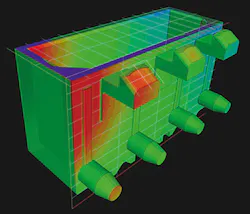
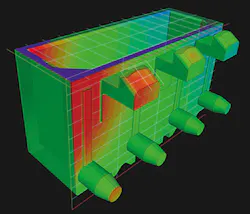
Volume Graphics has upgraded its metrology software. The options available with the newest iteration, Version 3.2, include the ability to determine whether defects flagged by a computed tomography (CT) scan are severe enough to scrap a part.
Volume Graphics' packages include VGStudio Max, designed for analysis and graphical representation of CT data; VGinLine, for automated inspection applications; VGMetrology, for dimensional analysis of the external surfaces of objects; and VGMetrology ES, a basic version of VGMetrology. Compatible with off-the-shelf PCs, the software can be used with CT scanners, along with tactile and optical scanners.
While Volume Graphics' packages have distinct advantages, they've all been designed to improve product quality, from the iterative design cycle to inspection before delivery. When things go wrong, the software also can be used to analyze part failures.
No matter which Volume Graphics package customers choose, Version 3.2 offers new options for them. For example, Volume Graphics offers as an add-on to its newest packages the Manufacturing Geometry Correction module. The new module provides calculations to help processors and mold makers better understand issues with molds or mold cavities that might result in part defects.
Available to users of VGStudio Max and the VGMetrology packages, a new intuitive alignment feature allows quicker alignment of CT scans to reference models. Additionally, users of the 3.2 versions of the packages can benefit from a function that averages data from the surfaces of multiple parts. When inspecting parts from different production batches, the company's so-called "golden surface" can help guide corrections to compensate for inhomogeneous process parameters.
Other new capabilities include upgrades to VGStudio Max's porosity analysis. Version 3.2 of the software now can calculate the mechanical ramifications of defects, such as short shots. The feature allows users to directly and numerically compare the stress simulated on a scanned part with an equivalent stress simulated on the nominal part.
SHAPEGRABBER
ShapeGrabber, which makes measuring machines and scanners, showed off a number of its dimension-scanning technologies at NPE2018. The models included the brand-new ai620 automated 3-D laser scanner, as well as the company's QVI FlexPoint coordinate-measuring systems, which have only recently been marketed to the plastics industry.
The ai620 is a mid-size scanner that tracks the points of parts, said Tom Groff, the VP of North American sales of optical gauging products for Quality Vision International Inc., Rochester, N.Y., which owns ShapeGrabber. Compared to its predecessor, the ai600, the ai620 is twice as accurate and fast, thanks to improvements to its head. The laser skims over parts, taking measurements as it goes.
"It's basically painting that part and giving you all the data on that part," Groff said.
In addition to the ai620, ShapeGrabber also is marketing its QVI FlexPoint machines for the first time to the plastics industry. Offered in a range of sizes, machines in the series can handle both small and large parts. The machine heads can accommodate as many as three sensors, with a variety of available options, including point and line scan lasers, white-light sensors and a video sensor.
KEYENCE
Coordinate-measuring machines (CMMs) require operator expertise. Hand-held scanners lack precision. Both have their advantages, though, and it's those benefits that Keyence is accentuating with a device that brings the technologies together.
The XM series, which employs a hand-held scanner and a scanning stage, has undergone recent updates, said Michael Vincent, sales project specialist for the company's hand-held CMM team. The scanning stage, where samples are affixed for imaging, is now bigger and rotatable, allowing operators to scan an entire sample without moving it. The scanning bed accommodates parts up to 5 feet across, compared with only 1 foot previously.
Vincent demonstrated the scanner by pointing the hand-held device at a sample atop the scanning bed. A non-contact probe mapped the object, as video of it played on a monitor. The device is accurate to within 8 microns and has been adopted by makers of molds and automotive and aerospace parts. And, unlike traditional hand-held scanners, it also offers a high degree of repeatability — to within 3 microns.
In all, about 2,000 XM systems have been installed in each of the past two years, Vincent said.
"This is good for everything with tight tolerances," he said.
MITUTOYO
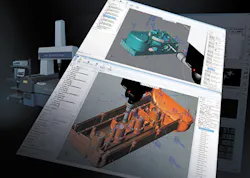
Metrology equipment maker Mitutoyo has made its CMMs easier to use with the February release of its updated MiCat Planner software. It showed off Version 1.5 at NPE2018.
J. Dean Dornbaugh, a sales engineer for the company's CMM/vision unit, said the software update significantly reduces the amount of time required by operators to program CMMs to recognize and measure parts from a computer design, such as a CAD model. "It standardizes the way programs are generated," he said.
Using the software, operators can directly embed geometric dimensioning and tolerancing (GD&T) information into a CAD model, or manually input the information later, using the software's GD&T Wizard. According to the company, the software automatically plots and optimizes a measurement path, reducing measurement times and the possibility of inspection probe/part collisions.
GD&T information tells the CMM what to look for in measuring a particular component or part. With it, the CMM can flag dimensions that are outside accepted parameters. The software allows operators to check parts from a desktop computer or other device, even when the CMM and object that it's measuring are somewhere offsite.
Depending on the complexity of the part, Dornbaugh said the software update can reduce programming time by as much as 95 percent. With GD&T information directly embedded into CAD models and a rules editor within the software that standardizes measurement guidelines, the software also reduces the possibility for human error and variation.
Dornbaugh said the company's CMMs are used mainly by the aerospace industry, which demands especially tight tolerances.
VISION ENGINEERING
Designed for operator comfort and convenience, the microscopes from Vision Engineering bear little resemblance to the single-eyepiece units that conjure up images of lab-coated mad geniuses. But, then, they're not just intended for scientists.
"Not everyone needs high-end systems that require months of training," said Simon Cosham, the company's North American metrology sales manager, as he directed a tour of his company's NPE2018 booth. "They just need to measure accurately."
For them, the company offers a multitude of microscopes that address some of the issues of people who might not otherwise like microscopes: Vision Engineering's scopes are designed so that users can view samples with their eyeglasses on, sitting up, rather than hunched over. Many have a single viewer, similar to a virtual-reality headset, that allows a user to look at samples with both eyes at once, rather than through a single eyepiece.
The newest model, the Evo Cam II, doesn't even require looking down at all — samples are displayed on a monitor.
Launched a couple months ago, the digital microscope has built-in LED illumination, a USB hookup and wireless capabilities, allowing images taken by the camera to be transferred to other devices, where they can be loaded and viewed. It provides optical magnification of up to 300 times and employs a camera that can take pictures that can be downloaded to a computer. It comes with a wide variety of optional accessories, including filters and different lighting arrangements that can accentuate details, depending on the type of sample.
Richard Nagel, VP of sales and marketing, particularly touted an option that makes it possible to see 360 degrees around a sample — without ever having to move the sample or refocus. This optional, special attachment not only makes analyzing a sample easier, it also prevents unnecessary movement that could cause friction that might damage the sample.
Unlike a traditional two-eyepiece scope, or stereo microscope, the Evo Cam II provides superior depth perception and a bigger field of vision. Nagel said the instrument is suitable for pass/fail inspection of parts manufactured for a variety of fields, including the medical, electronics, aerospace and satellite-making industries; to guide them, operators can even overlay images of designs of the samples against the sample itself.
DUNWELL TECH
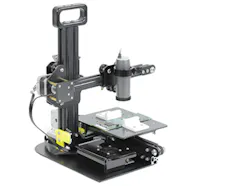
Dunwell Tech, the U.S. distributor of Dino-Lite-brand microscopes made by AnMo Electronics Corp., New Taipei City, Taiwan, showed off some of its newer instruments at NPE2018, including the AM73915MZT and its sibling, the AM73915MZTL, which features a longer working distance. The hand-held microscopes can take pictures of samples, at a maximum speed of 45 frames per minute, in a variety of formats including JPEG and PNG. In addition to releasing the scopes, the company also has recently updated its motorized stage.
Imaging consultant Sean Olesen said the AM73915MZT and AM73915MZTL bring together all the most sophisticated features of the Dunwell-AnMo offerings. They include auto calibration; the use of replaceable USB 3.0 cables; extended depth of field, or EDOF, which allows users to automatically capture multiple images and different depths and combine them into one clear image; flexible LED control, or FLC, for making adjustments according to LED brightness; and Snap mode, which zeroes in on the edge of a sample being viewed, so that the user can more easily take digital measurements of the area. The scopes, which come with free software, also have a bar-code reader.
The AM73915MZT has a magnification of up to 220 times, while the AM73915MZTL has a magnification of up to 140 times. Applications include quality control and testing.
In addition, users of Dino-Lite scopes also can benefit from the pairing of new software with the Vision M1, a controllable stage for microscope samples that provides positioning in the X, Y and Z directions in respect to the eyepiece. With the Shuttle software made available late last year, the stage can produce Z-axis movements in increments as small as 20 microns and 100 microns for the X- and Y-axes.
Karen Hanna, copy editor
Contact:
Dunwell Tech Inc., Torrance, Calif., 888-668-2442, www.dinolite.us
Keyence Corp. of America,
Itasca, Ill., 888-539-3623,www.keyence.com
Mitutoyo America Corp.,
Aurora, Ill., 888-648-8869,www.mitutoyo.com
ShapeGrabber Inc., Ottawa, Ontario, 613-247-1707, www.shapegrabber.com
Vision Engineering Inc.,
New Milford, Conn., 860-355-3776,www.visioneng.us
Volume Graphics Inc.,
Charlotte, N.C., 704-248-7736,www.volumegraphics.com
About the Author
Karen Hanna
Senior Staff Reporter
Senior Staff Reporter Karen Hanna covers injection molding, molds and tooling, processors, workforce and other topics, and writes features including In Other Words and Problem Solved for Plastics Machinery & Manufacturing, Plastics Recycling and The Journal of Blow Molding. She has more than 15 years of experience in daily and magazine journalism.