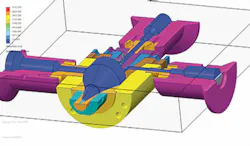
Computational fluid dynamics (CFD) technology used in simulation for film and sheet dies is being adapted by one company to design annular dies used in tubing extrusion. Final products that could be made with these dies include tubing for medical applications, microbore tubing, insulated fine wire and multilayer automotive or irrigation pipes.
CFD technology can't eliminate all design flaws or inefficiencies. However, it does the next best thing: It provides computer-generated models that allow users to test and optimize their designs before the dies are built.

B&H Tool Co. LLC, San Marcos, Calif., a designer and manufacturer of custom extrusion tooling, has added CFD analysis to optimize its annular dies for extrusion. The CFD software is fully integrated with B&H's CAD program and CAM package. John Ulcej, a partner at B&H, as well as its director of engineering, came from the film and sheet extrusion industry. That became the impetus for applying this technology to dies for tubing, especially in multilayer applications.
"Management's strategy is to bring the same approach to annular dies, such as crossheads and inline dies, for single-layer and coextrusion applications," said Peter Neville, managing partner at B&H. "We want to bring what worked in film and sheet dies to annular dies."
Due to the cost and sophistication of these types of dies, CFD analysis was important to lower the risk and ensure tooling quality, Neville said. CFD is used for all types of annular dies, including adjustable center, fixed center, coextrusion, inline and inline spiderless dies. Film and sheet extrusion demands an even material flow to the exit of the die; therefore, the simulation technology is applicable to multilayer tubing. Neville used irrigation tubing as an example, where postconsumer resin might be used to bring down the cost. By using CFD, processors can make sure that the rheology of regrind is taken into consideration. In coextrusion applications, the demands include getting the correct volume for each layer, making sure all layers are flowing at the same velocity, and taking into consideration the pressure profile. With CFD, B&H can create annular dies that deliver uniform polymer flow to the exit of the die.
In another example, B&H has found that medical device manufacturers of high volume, low-margin PVC fluid/air transmission tubing have, in some cases, been using inline dies that have too much volume. This can lead to excessive burning and premature shutdowns. By using CFD, simulations have shown that smaller, low-volume head assemblies work better for relatively low-output applications.
CFD is a powerful design tool, but it's not omniscient. The processor has to provide the rheology of the polymer, the flow rate, viscosity and shear rate to B&H so it can model the melt at a given temperature.
The process can begin with two required inputs: polymer rheology and a target output rate. With these inputs, B&H designers tailor a head assembly to a customer's application. If a customer has multiple applications, the engineering team can help determine what the customer wants the target output rate to be.

The market is ripe for this type of innovation, Neville said. Analyzing output rates as a function of pounds per hour has been a big step forward for processors. However, in many instances, companies have not been looking at their tooling as an area of improvement. B&H's goal with CFD, in part, is to encourage companies to look at tooling from a different perspective and help them optimize their tooling before any problems occur. Often, companies develop quick patches to compensate for uneven flow in their tooling.
"There is a lot of flexibility to the process, and we can even design multiple deflectors if their output rates are too varied," Neville said of using CFD.
The computer-generated models created using CFD eliminate real-world trial and error, minimize downtime for cleaning and prevent uncontrolled head pressure as well as restrictive line speeds, he said.
"With CFD, we can look inside the head and see what the flow is like, measure the pressure profile in the tool head and address issues in round dies such as knit lines," he said. "Use of CFD results in optimized tooling that leads to a stable process and better products."
When the CFD analysis is run, users can view pressure, velocity and temperature by evaluating the flow of material through the tool. Color-coded charts relate to pressure, temperature or flow through the crosshead die. "CFD software is used to ensure the volume in the crosshead is proportionate to the split material layers in a multicavity tubing construction," Neville said.
Processors provide B&H with output values for the tool, such as temperature, pressure and flow. The output rate corresponds to the specific line speed that the user must maintain to be profitable. B&H designs the tooling for that output to keep shear and viscosity constant. "Optimizing the die design stabilizes the process and the output," Neville said.
B&H, which will mark its 50th anniversary in 2017, has installed 10 to 20 crosshead dies designed with CFD, including a crosshead die producing three-layer tubing for a medical molder based in Mexico.
Mikell Knights, senior correspondent
Contact:
B&H Tool Co., 800-272-8878, www.bhtool.com