HP IF printers process engineering resins
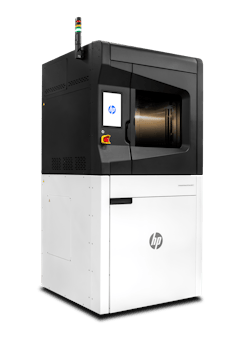
HP Industrial Filament 3D Printer 600 High Temperature (HP IF 600HT) HP’s new modular industrial fused-filament-fabrication (FFF), continuous 3D printer can process high-temperature resins and engineering-grade polymers, including acrylonitrile butadiene styrene (ABS), polyetherimide (PEI), PC and polyetheretherketone (PEEK) and polyaryletherketone (PAEK), as well as fiber-reinforced materials, such as polyamide-carbon-filled (PA-CF). Designed as an open-materials platform, it has a modular printhead system and uses interchangeable printing modules — known as the HP IF 3D Printer 500, HP IF 3D Printer 360 and HP IF 3D Printer 280 — tailored for different material families, with possible processing temperatures ranging from 176 degrees Fahrenheit to 932 degrees Fahrenheit. To automate material drying and conditioning, HP’s Material Management System (MMS) also is available, which makes it possible to always have on hand materials that are ready to print. The printer boasts intelligent thermal control, a rigid mechanical architecture and precise motion system.
What’s new? The printer, available the first half of this year.
Benefits Consistent quality, repeatability and flexibility, using high-performance materials like PEEK and PAEK. Users can set up print jobs quickly and produce high-strength parts with consistent results, and because the printer is compatible with an open materials platform, it is flexible. The printing process offers full traceability.
HP, Palo Alto, Calif., 650-857-1501, https://reinvent.hp.com/us-en-3dprint-filament3dprinter600HT
Vital Statistics
|
Build volume |
15 inches by 15 inches by 16.5 inches |
|
Minimum layer height |
50 microns |
|
Number of print heads |
2 |
|
Filament diameter |
1.75mm |
|
Maximum printhead temperature |
932 degrees Fahrenheit |
|
Maximum build-plate temperature |
374 degrees Fahrenheit |
|
Chamber temperature |
383 degrees Fahrenheit |
|
Filament-chamber temperature |
122 degrees Fahrenheit |
About the Author
Karen Hanna
Senior Staff Reporter
Senior Staff Reporter Karen Hanna covers injection molding, molds and tooling, processors, workforce and other topics, and writes features including In Other Words and Problem Solved for Plastics Machinery & Manufacturing, Plastics Recycling and The Journal of Blow Molding. She has more than 15 years of experience in daily and magazine journalism.