Impossible Objects launches CBAM technology
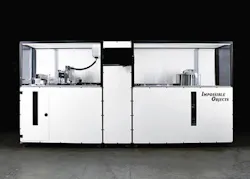
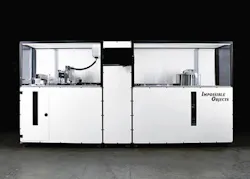
Impossible Objects' composite-based additive manufacturing (CBAM) technology made its debut last month at Rapid + TCT in Pittsburgh, where the company displayed a model of its pilot machine, Model One.
Company founder Robert Swartz said that the technology uses conventional thermal inkjet heads. It uses sheets of fiber fabrics bonded with thermoplastic matrix materials, such as nylon or PEEK, Swartz said. With the composite materials, the end products have better strength characteristics than those made by other 3-D printing processes.
"We print the layer on the carbon fiber," he said during an interview at Rapid. "We then flood onto that a thermoplastic polymer powder. The powder sticks to where the fluid was deposited, and we vacuum off the excess polymer."
The sheets are stacked, pressed and heated to the powder's melting point, producing a solid block of material. Any excess carbon fiber hanging from the block is sandblasted away to achieve the final part shape. The build speeds are 45 cubic inches per hour or greater. The build volume ranges from 384 cubic inches to 768 cubic inches. Sheet sizes can be selected by the user, with options of 12 inches by 8 inches; 12 inches by 12 inches; and 12 inches by 16 inches. Layer heights are 0.0016 inch to 0.002 inch, depending on fiber selection.
Although the printer can stack sheets only to a certain height, the stacks can be removed from the printer and placed atop each other to reach virtually limitless heights. "In our machine you print, and after you print, the sheets get stacked. But you can keep printing [and stacking the sheets to gain] more and more height," said CEO Larry Kaplan.
"In long term, our goal is to compete with injection molding," Swartz said. "We can reach injection molding speeds, achieve the geometric complexity, with no tooling costs."
Swartz said he has seen tremendous interest from companies that want a single 3-D printer that can handle higher-volume manufacturing using materials that they cannot get elsewhere.
"Until now, there was no way to print functional parts with the mechanical and material properties at the scale these companies need," he said.
The machine currently is in a pilot phase and will be available for purchase by early next year. Initial pilot program companies include contract manufacturer Jabil Circuit Inc., St. Petersburg, Fla. People at companies interested in the pilot program can e-mail Impossible Objects at [email protected]
Angie DeRosa, managing editor
Contact:
Impossible Objects,Northbrook, Ill., 847-400-9582, www.impossible-objects.com