Mark Strachan makes waves at OMV Technologies
Key Highlights
- Mark Strachan advocates for viewing plastics as a resource rather than the enemy, emphasizing education to change public perception about plastic pollution.
- He has a lifelong passion for plastics, stemming from his family’s business, and has worked extensively across Europe and the U.S. to develop high-quality, durable machinery.
- OMV Technologies specializes in high-volume, turnkey thermoforming systems, with a focus on machine longevity, automation and retrofitting legacy equipment for improved efficiency.
- The company is expanding its U.S. presence with a new plant in Michigan to provide local support, training and manufacturing, reducing reliance on overseas supply chains.
- Strachan emphasizes sustainability through advanced processing techniques, recyclable materials, and energy-efficient machinery, aligning industry practices with environmental goals.

The oceans and plastics can be a volatile mix.
But for at least one man — thermoformer maker OMV Technologies CEO and co-owner Mark Strachan, the son of industry pioneer Ian Strachan — there’s harmony in both.
As he travels the world with his high school-aged daughter, transiting between his own homes in Jupiter, Fla., and Verona, Italy, and his sister’s home in Australia, he’s chasing a variety of passions — including training the next generation of plastics workers. He’s also absolutely in love with the oceans; in addition to other outdoor activities, he regularly kayaks about 30 miles a week.
In mid-January, he talked water, plastics, world travel and the potential for a U.S. manufacturing facility with Karen Hanna, senior staff writer for Plastics Machinery & Manufacturing.
Is it possible to love both plastics and the oceans?
Strachan: The biggest reason plastics is targeted as the bad substrate for packaging is because it’s the one that floats onto the beaches. It’s really a trash problem — the cans, the bottles, the paper, all on the bottom of the ocean. I’m a scuba diver, and I go down there with a big bag around my waist, and I always pick up bottles, cans, paper products, everything, all sunk down to the reef. But nobody sees it down there. I see it, and I’m alarmed. People walk on beaches, and they only see plastic.
I wish we could somehow get around that and educate people [plastic is] not the enemy.
How did you get into plastics?
Strachan: My father owned a plastics company in South Africa, in Cape Town, manufacturing all types of cups, trays, paper and plastic. I pretty much fell in love with plastics. Then, I did military service for two years; we were drafted. After that, my father had an opportunity for me to work in Germany and study plastics, polymers. I bounced around Europe for the next 10 years, working hands-on in plastics. Made it to the United States in about ’95 and worked for Sencorp [Systems] on Cape Cod for five years. Then they sold the company, and I left. I started my consulting back then, for about 27 years. Opportunities came up to purchase OMV, because OMV was being sold by Polytype [OMV’s] plastics division. I opted in and joined forces with [now OMV Technologies President Brooke Maltun’s] father, Dana Maltun, and we bought OMV about four years ago.
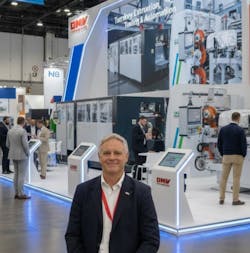
We pride ourselves [on producing] extruders, thermoformers, entire turnkey systems. We machine our parts. We have a full-fledged tool shop, so we’re able to produce our own tooling. We are one of the few companies that supply complete turnkey systems for the industry, including training.
We are more of a boutique manufacturer, because our machines are large and very high-volume, and they typically are not [for] a lot of tool changes. It’s more for very high-volume products, but we make different sizes, so you can meet whatever [is] required.
How is business now?
Strachan: Business is picking up nicely. The tariffs in the United States against the countries that typically [supply] products like cups, trays, clamshells and all that, they’ve opened new opportunities in the United States. Now, everybody’s having to quickly ramp up and produce products in the USA. We’re working with several customers outside the USA who are investing and moving to the USA to manufacture those products, which for so long [have been] bought from China, Taiwan, Indonesia. I was amazed how much plastic packaging and paper we actually import from the Far East and [the] opportunity ... to take over those markets and produce it in the United States.
Could you provide some more background on OMV?
Strachan: OMV was actually started in 1963 by the Padovani brothers. After I bought the company, and I was able to study the intellectual property and patents, I was amazed to see they were in the forefront of extrusion and thermoforming. Over the years, I had the opportunity to deal with OMV as a consultant to companies. When I was working in South Africa with my father, he had OMV machines, along with Illig and other machines. OMV was the first to launch polypropylene machines. And then, of course, competition grew, and later on, change of ownerships and all that, OMV was slowly whittled down.
So, I was very familiar with OMV machines, but during COVID, I was called to help with Mac & Cheese from Kraft Foods. In Chillicothe, Mo., they have two of the flagship machines of OMV, the RM77 high-speed machine that makes products extremely well. [Despite the COVID lockdown] I had a special permit from the government to travel because I was making masks and all that. But Mac & Cheese went up six-fold in sales; so did Jell-O, because the kids were at home.
I worked on these machines. I had to ramp them up and get them running more efficiently. I was just blown away by the RM77.
At that time, just after COVID, the company was up for sale. That was my decision-maker to buy OMV: We have focused on very high-quality, high-precision machinery with a lot of longevity. As soon as I bought the company, I started traveling the world to visit customers who had these machines. I found … machines that were running for 30, 35 years, and in some cases, the machines looked as good as the day they were bought. ... There’s nobody making machines [with] this type of longevity.

As new ownership, we’ve decided we don’t want to change anything other than new components. In the old days, hydraulics were very popular. Being an electronics engineer, I decided to replace these hydraulics with servo-electrics. We’ve been upgrading all the old equipment to offer better efficiency, better energy consumption, more precise actuation … and, of course, a lot more user-friendly by having [a] better operator interface. Because I’ve got such a brilliant electronics and automation team, we’ve also included data acquisition on the equipment.
What kind of container do the RM77 machines make for Mac & Cheese?
Strachan: You know the round tub that you put in the microwave?
What other advances are you working on?
Strachan: There’s a huge drive, or even legislation, moving us away from materials that are not recyclable, not considered environmentally friendly. When I first bought OMV, I call it the plastics debacle broke out where single-use plastics became really frowned upon, and paper very quickly was replacing that. But now … people are realizing that paper substitutes are not sustainable for many reasons. … The problem has been that paper does not hold liquid, and it either has to be coated with a thin plastic film, or it has to be coated with a lacquer, and, in the worst-case scenario, they embed it with PFAS, which are poisonous. So, a lot of that product coming from China has PFAS, and I think that’s one of the reasons why there’s huge tariffs on it now.
Plastics are recyclable if properly handled and … if they keep this as close as possible to a single-source plastic.
We’re clamping down on stickers that are used on PET. The [Association of Plastic Recyclers] APR, they’re getting a lot more of a handle on plastic, so that it becomes more sustainable.
One of the great things, whether they decide to go to PLA [polylactic acid], compostable plastics, polypropylene or PET, it’s all thermoforming machines. It’s all good business for us.
We are working with these companies and our customers to ensure we can produce more sustainable options. I always tell everybody, “You can make a plastic pot on any machine, but can you make it efficiently and cost-effectively and produce good-quality parts?”
At OMV, we have the solution to make sure we produce the highest quality, most sustainable [parts], and make sure the products are all functional. Our efficiencies are typically in the 95 to 100 percent [range].
Plastics, already being on the low spectrum of carbon footprint of manufacturing when compared to paper, metal and glass, that’s a biggie. What we’re [trying] to ... be more sustainable, we have processing techniques on the OMV machines for better material distribution. We want to make sure those efficiencies are high, so you’re not putting energy into a pot and having to recycle it because it doesn't meet standards.
We’ve been working closely with a company, the SMC Group in Italy; they make microwave dryers. It’s using a lot less energy and time to bring the plastic down to the dew point you need.
If your machine can run more efficiently and precisely, you can actually downgauge and run a thinner sheet more consistently.
When you add additives to plastic, it adds cost. You want to be as additive-free as possible. Let’s say you want to reduce the cost of polypropylene, they’ll put a mineral in there — calcium carbonate — but that gives it more weight, so it sinks, so it can’t be separated in the density tanks they use in recycling.
We want to make polypropylene clearer, so we’ll add a clarifier. We want to make sure the PET doesn’t stick, so we put an anti-block in so it doesn’t have static hold on the cup or the surface tension that holds the cups together. Of course, we try and design around that wherever possible. Having the techniques and preciseness is important to make sure you don’t have to over-engineer them, so you can get around those needs for additives.
Have you developed innovations that can be retrofitted to OMV’s legacy equipment?
Strachan: The biggest driver for customers wanting to or [to] not replace machines [is] having to reinvest in tools, because every machine has different tool sets, and those are pretty costly. In most cases, when we build a new machine, we build it to be able to utilize those older tools.
Being an ex-military man, one of the things you learn is “no man left behind.” When I took over, we weren’t supporting the older machines … so, I said, “No, let’s start what I call now, ‘no machine left behind.’ ” We vowed to support every machine out there still running today. We went and studied each of those: “What can we replace on those machines to bring them up to standard?” We started off with the plug-assist, which actually pre-stretches the plastic. We were going through the entire machine and seeing where we can take out hydraulics, pneumatics, where we can improve the electronic [and] heating elements.
We have blackface quartz ceramic heaters that are very efficient.
We are upgrading old machines, bringing them up to new-machine standards and efficiencies, including entire downstream stacking devices. We’ve actually in some cases cut the back of the machine off and added an entire downstream [system] to handle automation, because … it’s tough for producers to find labor, skilled labor, and also, the machines, in some cases, like our RM77 — that goes as fast as 55 cycles a minute. You’ve got a lot of product coming out the back of the machine, and you need a lot of people to package those products into bags. We have customers making the party cup. They have to put them in 20-count bags, so they … need a lot of people bagging these cups. We’ve been working extensively on downstream automation, so the cups coming out at that speed and volume can be handled automatically by downstream automation, all the way to finish-palletizing without anybody touching it.
Many of our lines now, especially our high-speed lines, are running completely hands-free.
What other challenges are you helping customers address?
Strachan: The biggest challenge is the availability of personnel to pack and inspect. It’s a laborious job to pack cups all day; it’s hard to find people to do that.
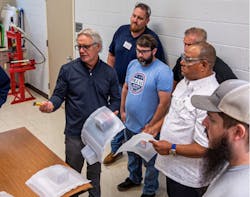
When I left Sencorp … people wanted me to consult, because there was such a need in the industry for training. So, I developed the Paulson training program. I started developing that in ’95. … I’m going out and training them right now, because there’s a dire need for trained personnel. I’ve brought in a couple of other ... people ... out of retirement, and have them train people as part of [what] we offer from OMV.
It’s still tough for us, getting around the tariffs for machinery supply, still making out of Italy. … We have our facility in West Palm Beach, Fla. We have a facility where we supply spare parts. But we are working along with Cemaks [Industrial Inc.] out of Turkey, because we don’t make multi-station machines. I’d rather align myself with machinery manufacturers who make part of a machine that I believe is better-suited for a particular product. They have an excellent machine for lids, so I utilize them for our customers who want to make lids.
We have the capability now in our lab, and we’re also selling it with our equipment, to put foam in the center layer of the sheet. We use Promix [Solutions AG], out of [Winterthur,] Switzerland, and we’ve had a lot of trials from some major converters in America. They’ve come over to work with us, and along with the SMC microwave dryers, we have that on the back of our lab line, as well.
Would you ever consider manufacturing OMV machines in the U.S.?
Strachan: We’ve been working on a plant in Michigan. We have a gentleman who’s retired from the plastics industry who’s up there working with us, because ... I needed someone who knows the industry [and] machinery well. [It’s going to be a] final assembly plant, where we bring components and source them from all over, then build the machines and ship them out from there. Eventually, we’ll try and produce more components in the USA and buy the steel, which is required in the USA. The big thing is the labor.
What would be the timeline for the U.S. plant?
Strachan: We already have a facility in Kalamazoo, Mich., and are planning to set up a testing lab and service center there and will commence with some of our machinery assembly work there as well by the end of 2026.
What motivated you to start up a U.S. plant?
Strachan: It was a long time planning. We wanted better support for our customers locally, rather than having to bring them in from Italy. I had the most amazing laboratory set up in Florida, [where] I was doing training and product development and all that. That was bought out by another company. So, I lost that laboratory, which had taken so many years in building up. One of the biggest drivers was to set up a facility where I could have hands-on training. I’ve been teaching at Penn State College of Technology in Williamsport for the last 14 years. Every year, I do hands-on training. This year was the first time I didn’t do it. ... It’s always been my goal to have that same setup in the United States where I could hold hands-on seminars in this laboratory, which would double as a product development site for OMV and a manufacturing center eventually.
Why is training important to you?
Strachan: I love the industry. I’ve loved it ever since my father got me involved with it, my father being a plastics man his whole life — he’s 88 today, and he’s still consulting. I’ve always been passionate about plastics. I also love to see the “aha” moments. I’ve pretty much had the heart of a teacher for most of my life. I’ve seen so many young kids come in and now doing so well in the industry. I’m teaching a lot in Canada, and I’m seeing some amazing young Indian engineers. I’m training them, and I’m amazed by the quality and training they get as engineers. I’m hoping we can instill that same level of engineering training, especially process training and plastics, in America, to the American population. We still have a lot of immigrants from ... all these places, and I’m finding them extremely good to work with. You have a lot less in our industry that are actually American-born.
I find it very rewarding teaching and seeing them successfully integrate into the industry.
What kind of advice do you give to those folks as they’re starting in their career In plastics?
Strachan: It’s fast approaching the time where the old pioneers are all aging out, retiring — people that have a lot of experience in industry, 30-40 years experience. It’s going to get to a point where all you can do is watch them on videos, but ... latch on to those [with] experience. Just absolutely absorb everything they have to offer. Find a niche, get really good at it. There’s polymers [with] certain challenges. Find out how to do it; find out how to do it better; find out ways to make the machines run better. Learn whatever you can. Don’t have tunnel vision; broaden your horizon.
I’ve traveled the world for so long, and I’ve touched almost every polymer out there. I’ve been to many companies around the world, worked hands-on in those companies with different nationalities, different races. I got to a point where I understand the people, the machinery. What I [found] when I [came] to America is that a lot of the younger generation, or even some of the older ones ... all they know is one platform or machine. The rest of their time, they’ll just push that one platform and say, “This is the best machine.” But I'm not going to say OMV is the best machine for everything; you need to know there’s machines that are better for a certain product. Open your mind, look and see what’s going on in the rest of the world and industry. Take in as much as you can. Find a niche, and you become more valuable.

What do you like to do outside work?
Strachan: I’m based in Jupiter [Florida], with my 16-year-old, but I travel extensively. She lives with me full-time. She’s in online school, so she can travel with me when she wants. We [did] South Africa last year. We did Italy. We did parts of Europe. We did Australia. Basically, I go every other month to Italy for about two weeks. I’m traveling every week. When I’m in Italy, I try [to] stay in Verona and do whatever I need to do. On the weekends, I go sailing and kayaking, or if it’s winter, I go into the Alps snowboarding. I like to just disappear into the mountains with friends. Work hard, play hard.
I’m an ardent kayaker. I do a lot of long-distance paddling, three times a week, just go out into the ocean and paddle for hours, sometimes in the middle of the night.
And I’m a sailor. I have a sailboat in Florida.
Does that mean sustainability issues hit especially close to home?
Strachan: Yeah, absolutely.
My daughter wants to be a marine biologist, and she’s very passionate about the oceans, gives me a hard time about plastics. Of course, she’s only a teenager.
We’re both very passionate about doing whatever we can for the environment. I find myself washing all my plastics and pulling the stickers off before I put them in a recycle bin. I find myself getting very upset when I walk past recycling cans and I find the wrong product in the can.
How much longer do you think you’ll be doing this?
Strachan: I still want to keep going. My dad’s still going. I would like to kind of semi-retire, maybe when I’m around 70-75. But I think I’ll keep going, and I definitely will keep consulting. We [have] got wonderful pioneers in industry. ... And I hope to be like them, and like my father.
What would you like your legacy to be?
Strachan: I’ve always tried to put others first, and always [believed], “Do unto others, what you expect them to do unto you.” ... I think people know me as a trainer, just my passion for the industry ... to get more people involved in the industry and properly trained. I’m very passionate about training. I’m very animated. I love people, and I always want to know their stories.
Just the facts
WHO IS HE: Mark Strachan, CEO and co-owner of OMV Technologies, Verona, Italy
NUMBER OF EMPLOYEES: About 25 people as permanent staff, plus retired personnel and contractors
AGE: 61
About the Author
Karen Hanna
Senior Staff Reporter
Senior Staff Reporter Karen Hanna covers injection molding, molds and tooling, processors, workforce and other topics, and writes features including In Other Words and Problem Solved for Plastics Machinery & Manufacturing, Plastics Recycling and The Journal of Blow Molding. She has more than 15 years of experience in daily and magazine journalism.