Robots allow recycler to recover a new material
By Ron Shinn
It seems like a no-brainer today. Rumpke Waste & Recycling was picking polyethylene terephthalate (PET) out of the curbside rubbish it collected in the Cincinnati area and the rest of the plastic — including 40 to 60 tons a month of polypropylene (PP) — was being sent to a secondary processor.
But a combination of events enabled Rumpke to turn that PP into a valuable new revenue stream. Increased demand for PP, two grants totaling $587,500, improved processing technology and rising value for the material all played a part. The risk Rumpke took on PP seems to be working out nicely.
“If I had 50 MRFs right now and I was picking PP at all 50 of them, I could sell every single bit that I could get off the lines,” said Jeff Snyder, director of recycling at Rumpke.
In 2021, Cincinnati-based Rumpke received one of the first four $510,000 grants from The Recycling Partnership’s Polypropylene Recycling Coalition. A second grant worth $77,500 is coming in 2022. The grants are designed to encourage material recovery facilities (MRFs) to increase sortation of PP, which can be used in a wide range of products, from food packaging to truck parts.
Rumpke used the grant as part of a $1.6 million total investment to purchase three robotic pickers, wider conveyors and to make plant modifications needed to accommodate PP sorting.
“We did a test of how much PP was actually in our system,” Snyder said. “We determined we had to have a robotic system that could make 200 to 220 picks a minute to be able to support the PP that was coming to our line. I would estimate that it is in the range of 40 tons to 60 tons of PP a month.”
Snyder said that three SamurAI robots from Machinex Industries Inc. can meet that requirement. Although Rumpke considered other robot brands, it settled on the SamurAI models because Rumpke’s MRF is equipped with sorting equipment from Machinex, a Canadian company.
“They really work well within our system,” Snyder said.
The first three robots were installed in late July.
Machinex claims its robots can make about 70 picks per minute, about double the rate of a human sorter. Snyder said Rumpke’s early experience agrees with the robot manufacturer’s advertised performance data.
The SamurAI robots use artificial intelligence (AI) to identify products made from PP. Product recognition improves as the robots learn through experience.
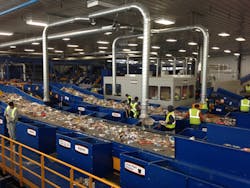
All recyclable commodities come into Rumpke’s Cincinnati MRF in a single stream. “We run the material off a conveyor belt through a metering bin that starts the process to get the material to a burden depth that makes sense,” Snyder said.
The next step is a pre-sort to remove anything that is not actually recyclable, Snyder said. Bulky rigid items are also pulled off the line. Corrugated material is removed next, followed by a glass-breaker to remove glass. Next 2-D and 3-D items are segregated in a step that uses screens and optics. Then steel food cans are removed, followed by items made with high-density polyethylene (HDPE) and then aluminum cans. The robots pick PP containers last.
The sorted PP is baled and bales are consolidated until there is a truckload ready for shipment to a plastics recycler. Snyder said the baled PP is sold to recyclers in the Midwest.
In addition to the robots, Rumpke had to install wider conveyor belts so the plastics could be spread out more to accommodate the robots. It also had to install and move some bunkers and chutes to get the PP to the baling step.
There has been a learning curve for Rumpke’s staff. “It has not been negative; it has all been very positive” Snyder said. Machinex staff helped MRF workers understand how the AI and camera systems work and adjustments they need to make.
“There is a lot of preventive maintenance that goes into the suction cups of a robotic head,” he said.
The robots are fully encased with only the arms exposed to the dirty waste stream. This reduces maintenance requirements on the motors and other components.
The Cincinnati MRF runs a first and third shift. Maintenance is performed during the middle of the day.
Return on investment for the PP project is expected to be 2.8 to 3 years, Snyder said.
The value of sorted PP is rising, which is good fortune for Rumpke. Baled PP is now selling to recyclers for 37 cents to 42 cents a pound. The price was in single digits when Rumpke did its initial justification for the robots.
“Obviously, we couldn’t see the future,” Snyder said. “We didn’t know the price was going to rise this much, but we are very happy with the PP pricing today. It’s going to help us get to our goal much quicker.”
What is fueling the rapid increase in value for PP? Primarily, recycling technology improvements and increased demand for recycled resin have now created a viable end market for post-consumer PP. Several recyclers have announced expansions this year to process more PP.
“Recycling technology has caught up with the product,” Snyder said. “They are able to take the color out, to make it clear and to get the smell out. Because of these things, they are able to make an end product that is comparable to virgin resin.”
Snyder predicts the market for recycled PP is going to be huge. “It is really unbelievable right now,” he said. “There are people lining up that want PP.”
Rumpke announced in January that it would accept PP containers in residential collection bins, but thus far there has only been a modest increase in the mount of PP it collects. Snyder said the company is in the process of testing the amount of PP in its stream to determine the current volume.
Rumpke also has a smaller MRF in Columbus, Ohio, where PP is now being sorted by hand.
The success of the first three robots at the Cincinnati MRF has caused Rumpke to purchase one more that was installed in September and a fifth scheduled for delivery in the first quarter of 2022.
The two additional robots will pick natural HDPE containers. Currently, HDPE is optically sorted and manual labor is used to remove anything that is incorrectly sorted and to separate natural from color HDPE. The robots are expected to handle all those tasks.
Robots have not replaced humans at the Rumpke MRF. “Nationwide, I think that is absolutely happening, but we are holding onto every person we can and using the robots to supplement our workforce.”
Snyder said Rumpke likely would have moved to robotic picking in the future even without the grants and the PP project, but it did push the adoption more quickly. “It is the next logical thing when you think about advanced technology in our system. We already have all the bells and whistles in our system,” he said.
“Our system runs 55 tons an hour, so it is very, very large,” Snyder said. “Robotics take it to the next level.”
Snyder said Rumpke is not interested in acquiring the recycling technology to turn its sorted and baled material into flake or pellets. “We are really good at collecting it. We are really good at sorting. That’s our niche and that’s where we are going to stay,” he said.
Snyder said that another consideration for taking on PP sorting was to open a new recycling market for its customers. “I guess you call it a soft benefit,” he said. “But being able to get recyclables to an end market so they can be made into another product is important. Can you really put a number on the value of that? I guess you can a little bit, but what a strong message we send to our customers.”
Ron Shinn, editor, [email protected]
About the Author
Ron Shinn
Editor
Editor Ron Shinn is a co-founder of Plastics Machinery & Manufacturing and has been covering the plastics industry for more than 35 years. He leads the editorial team, directs coverage and sets the editorial calendar. He also writes features, including the Talking Points column and On the Factory Floor, and covers recycling and sustainability for PMM and Plastics Recycling.