Robot orders jump in Q1 2026 for plastics and rubber sector
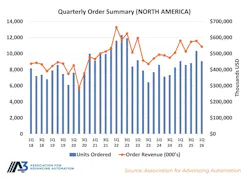
North American companies ordered 9,055 robots valued at $543 million in the first quarter of 2026, a 0.1 percent decrease in units ordered and a 6.4 percent decline in revenue year over year, according to the Association for Advancing Automation (A3).
The decline in revenue was driven largely by a cyclical drop in automotive OEM orders, which fell 35.1 percent in units and 48.2 percent in revenue year over year (YoY).
The plastics and rubber sector was a bright spot, growing 25.2 percent in units ordered and 32.6 percent in revenue YoY. Other segments showing growth included automotive component suppliers, life sciences, electronics, and food and consumer goods, pointing to continued diversification in automation demand, A3 said in a press release.
Alex Shikany, EVP of A3, called the growth in plastics and rubber a positive signal in a mixed first quarter overall. Orders in the sector declined in 2025.

“I would be careful not to attribute that to any single factor, but plastics and rubber manufacturers have many natural use cases for robotics, from machine tending and material handling to trimming, inspection, packaging and palletizing. These are applications where automation can help improve consistency, throughput, safety and labor efficiency,” Shikany told Plastics Machinery & Manufacturing.
“What’s interesting about plastics and rubber is that it reflects the broader diversification we’re seeing in robotics adoption. This is no longer just an automotive story,” he said. “Manufacturers in sectors like plastics are looking at automation as a practical tool to solve real operational challenges, especially around workforce availability, quality and competitiveness.”
Shikany encouraged plastics processors to attend Automate, the organization’s trade show June 22-25 in Chicago, to evaluate potential applications of robotics, vision, AI and automation technologies.
Companies ordered 1,637 collaborative robots valued at $69.8 million in Q1 2026, a 55.6 percent increase in units and a 78.2 percent increase in revenue YoY. Collaborative robots accounted for 18.1 percent of all robot units ordered and 12.9 percent of total order revenue during the quarter.
“Collaborative robots are one example of how the robotics market continues to evolve,” Shikany said in the press release. “The broader takeaway from the first quarter is that automation demand is becoming more diverse in terms of industries, applications and deployment models. That is an important signal for the long-term health of the market, especially as companies continue to invest in productivity, flexibility, quality and competitiveness.”
About the Author
Lynne Sherwin
Managing Editor
Managing editor Lynne Sherwin handles day-to-day operations and coordinates production of Plastics Machinery & Manufacturing’s print magazine, website and social media presence, as well as Plastics Recycling and The Journal of Blow Molding. She also writes features, including the annual machinery buying survey. She has more than 30 years of experience in daily and magazine journalism.