How USMCA uncertainty could affect plastics manufacturing investment
Key Highlights
- Annual USMCA reviews could delay machinery purchases, plant expansions and reshoring decisions by extending uncertainty over future trade rules.
- Plastics processors serving automotive markets face added planning challenges because vehicle programs and tooling investments span multiple years.
- Industry experts expect prolonged uncertainty to affect capital spending and cross-border supply chain decisions before border operations change.
- Plastics manufacturers should stay engaged with policymakers because future USMCA negotiations could shape North American manufacturing competitiveness for years.
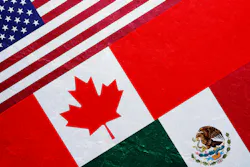
It's easy to dismiss the U.S.-Mexico-Canada Agreement (USMCA) as something to worry about years from now.
That might be a mistake.
A quick refresher: The USMCA is a trade agreement that establishes rules for duty-free trade between the U.S., Canada and Mexico. It was negotiated during the first Trump administration to replace the 1994 North American Free Trade Agreement (NAFTA).

The USMCA includes a check-in starting in 2026 to decide if the three countries want to extend it for another 10 years. Mexico and Canada said in July that they want to keep it in place without changes.
But the U.S. declined and said it is trying to negotiate changes to address trade deficits with Canada and Mexico. That decision triggers mandatory annual reviews for the next 10 years. If all three countries do not ultimately agree to extend the agreement, the USMCA expires at the end of that period.
The broad tariffs President Donald Trump announced July 24, including new tariffs on Canada, are separate from the USMCA review process.
Now back to the question of why it matters in 2026 as much as in 2036.
Kevin Ford, FX (foreign exchange) and macro strategist at Convera, a global financial technology company that specializes in cross-border payments and foreign exchange solutions, wrote before the U.S. decision was announced that not achieving a clean extension would prolong uncertainty for businesses making decisions on investment, production and compliance.
Ford said in a recent interview with PMM that for manufacturers, uncertainty shows up first in investment decisions. “Companies making long-term commitments — whether that means expanding production capacity, purchasing machinery, building facilities or reshoring operations — tend to pause when the future rules governing market access become less predictable.

“The risk is that uncertainty becomes institutionalized through annual reviews,” Ford said.
“If you drag us into a constant review process, you’re going to choke off investment,” the New York Times quoted Mexico’s economy minister as saying.
Ford told PMM that he expects to see the first effects come in capital spending and cross-border supply chain planning rather than at the border itself.
It is impossible to discuss the USMCA without looking closely at the North American auto industry. The sector has one of North America's most integrated supply chains and is critical for the U.S. plastics industry. A consortium of auto industry trade groups said in a statement: “The USMCA is a success story for the entire U.S. auto industry, with billions invested in US production and thousands of manufacturing jobs created.”
Ford said that for plastics processors serving the auto industry, the USMCA matters because auto production programs are planned years in advance. “If the review process becomes annual, suppliers may delay capacity additions, tooling, automation upgrades or cross-border sourcing decisions.”
The USMCA review process will not reverse reshoring, but it might slow it down. Reshoring requires capital spending for machinery, automation, plant space, tooling, labor and supplier qualification, Ford said. “If firms are unsure whether future rules will tighten around regional content, Chinese inputs, labor, forced labor compliance or tariff treatment, they may wait before committing.”
One possibility is that the U.S. continues pushing for changes while Mexico and Canada refuse. The next U.S. administration might renew the trade agreement.
“If companies knew today that USMCA would definitely be extended in two years, the impact would likely be limited,” Ford said. “The problem is that businesses cannot assume that. During that two-year period, firms would still be making investments, hiring, sourcing and expansion decisions without clear visibility into the long-term trade framework.”
Another possibility is that President Trump declares an end to the USMCA and tries to negotiate individual agreements with Mexico and Canada.
“For autos and plastics, that could be especially disruptive,” Ford said. “The supply chain is regional: resin, components, molds, machinery, parts and final assembly may sit in different countries.”
The U.S. and Mexico are major markets for Canadian mold makers, and Ford believes their position is safe, but “a prolonged review process could make sales cycles longer and investment decisions slower.”
The Plastics Industry Association (PLASTICS) and the American Chemistry Council (ACC), which includes a plastics division, have both spoken in favor of keeping USMCA but are interested in changes that advance their industries.
Plastics processors have political clout. Processors provide jobs and make significant contributions to their communities. Talk to your members of Congress who might have influence on the USMCA negotiations.
Waiting to see how negotiations unfold may prove to be the riskiest strategy of all.

Further reading
 U.S. and Canadian flags against a blue sky
 Logo for Plastics Industry Association (PLASTICS)
About the Author
Ron Shinn
Editor
Editor Ron Shinn is a co-founder of Plastics Machinery & Manufacturing and has been covering the plastics industry for more than 35 years. He leads the editorial team, directs coverage and sets the editorial calendar. He also writes features, including the Talking Points column and On the Factory Floor, and covers recycling and sustainability for PMM and Plastics Recycling.