For plastics manufacturers, immigration is a workforce issue
Key Highlights
- Manufacturers continue to face persistent labor shortages, while immigration enforcement reduces access to an important workforce pipeline.
- Foreign-born workers play an outsized role in manufacturing, with higher labor-force participation and lower unemployment rates.
- Plastics processors say immigrant employees help fill difficult-to-staff positions and often provide long-term workforce stability.
- Industry leaders warn that restrictions on both skilled and unskilled immigration could hinder manufacturing growth and innovation.
- Manufacturers, educators and trade groups increasingly advocate for immigration policies that support workforce development and economic competitiveness.
By Karen Hanna
Back in November, in the midst of an immigration enforcement surge that’s so far led to over 600,000 deportations, U.S. Customs and Border Protection (CBP) agents in the agency's Buffalo Sector made a big announcement: Working along the Interstate-90 corridor, its agents had detained 37 people and transferred them to the custody of Immigration and Customs Enforcement (ICE).
Meanwhile, not far off the interstate, in North Tonawanda near Buffalo, employees at Confer Plastics Inc. were hard at work, making snow sleds and swimming pool steps, pursuing, as the company proclaims on its website, the American Dream.
While his company’s employees are all authorized to work in the U.S., President Bob Confer has been watching ICE operations across New York with some concern. To him, immigrants have been— and always will be — a lifeline. As other manufacturers bemoan a labor shortfall, he takes pride in the cultural richness of the blow molding shop his grandfather started in 1973.
“You look at developments here in upstate New York, where they’re opening up a microchip facility in upstate — granted, it’s three hours away — and they need 10,000 workers. Where are they are going to find those workers in Syracuse or Rochester and places like that?” Confer asked. “We definitely need the doors to be open to bring in refugees and immigrants, because they are our future in these Rust Belt communities.”
Legal immigrants also affected by removal campaign
In a January press release, headlined, In a January press release, headlined, “Mass deportations are improving Americans’ quality of life,” the White House stated, “… President Donald J. Trump’s ironclad commitment to securing our border and enforcing our nation’s laws is liberating Americans from the crushing burden of unchecked illegal immigration. Through mass deportations, the Trump Administration is freeing up resources, revitalizing opportunity, and restoring safety. …”
According to the White House, more than 675,000 people have been deported since Trump began his second term.
Also, “nearly three million illegal aliens have left the U.S.,” and 2.2 million people have self- deported, according to a White House statement in February.
In January 2025, 53.3 million immigrants lived in the United States, according to a Pew Research Center report, but by June 2025, the foreign-born population lost more than a million people, marking its first decline since the 1960s.
Pew, a think tank that specializes in demographics analysis, estimated the undocumented immigrant population hit a record of 14 million in 2023 before likely dropping last year during the ICE surge.
Data released by CBP and ICE shed light on the agencies’ work.
Figures available in mid-May stated the agencies had made 230,354 arrests through the first seven months of the 2026 fiscal year, which will end Sept. 30. At that rate, they were on track to make 394,892 arrests, the most since the 2019 fiscal year, when in Trump’s first term in office, CBP and ICE made over 500,000 arrests. (The White House at one time acknowledged a goal of 1 million removals a year, as CBP and ICE got a funding jolt of $170 billion through 2029 in Congress’ spending package last summer, with tens of billions of additional funding still being debated at press time.)
“Due to President Trump’s immigration crackdown, the U.S. had negative net migration in 2025 — the first time in at least a half- century,” the White House website says.
However, claims that enforcement would focus on criminals are not borne out by the ICE and CPB data.
Since fiscal year 2021, of the people in ICE or CPB custody, roughly three-quarters had clean records, with no prior criminal convictions. That’s held true over the last two fiscal years, with about 71 percent of detained individuals having no prior convictions.
According to the National Conference of State Legislatures, about one-third of Americans overall have a criminal record — a higher percentage than those detained by ICE and CBP.
Removing workers from pool comes amid numbers crunch
At a time when policies have focused on removing immigrants from the U.S., manufacturers continue to struggle to find workers.
In an editorial last year, Kip Eideberg, senior VP of government and industry relations at the Association of Equipment Manufacturers, noted the paradox of cracking down on immigration while working to shore up domestic manufacturing already suffering from labor woes.
“The irony is that this workforce is already here,” he wrote in the Washington Examiner. “They pay taxes, support families, and help keep American industries competitive. Stripping their ability to work and threatening them with removal is not just a human cost; it is an economic one.”
Released in March, the first-quarter Outlook Survey from National Association of Manufacturers (NAM) found that 4.1 percent of positions were unfilled in the average manufacturing shop; roughly one in four manufacturers who responded reported rates above 5 percent.
According to preliminary, seasonally adjusted data available in late May from the U.S. Bureau of Labor Statistics (BLS), 462,000 manufacturing jobs were unfilled. While that’s fewer than half the manufacturing job openings reported during some months of the turbulent post-pandemic period of 2021-2022, a diverse range of experts — from professional services firm Deloitte and the Manufacturing Institute to the U.S. Chamber of Commerce — still warn the worst is yet to come, with the possibility of millions of unfilled openings in the next decade.
In April, according to seasonally adjusted BLS data, almost 696,000 people worked in the plastics and rubber sector. Within that sector, the unemployment rate was 3.2 percent in March, though it jumped to 5 percent — its highest level in 11 months — in April. Overall, the seasonally adjusted unemployment rate was 4.3 percent in April.
In May, the number of layoffs within the manufacturing sector dropped to 89,000 — the fewest since February 2021.
Manufacturing jobs lose steam among younger generation
Many manufacturers already have seen some effects of a labor crunch — especially as a large generation of people transitions into retirement, and a new, smaller cohort with different expectations moves in. Confer Plastics is bracing for impact.
To head off a bottleneck in its labor supply, the company is zeroing in on doing what it does best — making big items, such as kayaks and steps for patio furniture, to differentiate itself from other manufacturing shops, while cutting back on value-adds, like post-processing.
In a region that for decades lost population, the company employs 160 people, 43 of them born outside the U.S. in a roll call that evokes some of the darkest headlines over the course of the shop’s existence: Vietnam, Myanmar, Sudan, Iran, Bosnia.
“I look at this as being a two-way street, where the countries they come from tend to be living hells,” Confer said. “And I look at America as being heaven on Earth, so they can come here and live the American dream and have a better tomorrow for themselves. And, by doing so, they do the same for their coworkers, the company and also our customers.”
Native-born Americans just aren’t filling all the jobs made available by retiring workers, said entrepreneur Jeremy Jacobs, who provides software for manufacturers through his company, UnDesked.
“We have hundreds and hundreds of some of the biggest companies in the world that use our platform,” Jacobs said. “But along that process, what we started to recognize was there was an even bigger problem, and it was that there’s just not the workforce needed in America for these jobs. You know, 16-year-old boys want to be social media moguls or AI engineers. … What they’re not excited about is getting into manufacturing, which is a big cultural shift.”
Chasing the American dream
Available research indicates that immigrants — both documented and undocumented — make up a disproportionate segment of the workforce.
Within manufacturing, foreign workers have been a major resource, said Jacobs, whose UnDesked software leverages artificial intelligence (AI) to translate manufacturers’ documentation into dozens of languages.
“There’s a whole lot of people that came to this country as refugees, on asylum or through the proper immigration channels. There’s literally tens of millions of them. They want to work,” he said.
Between 2024 and 2025, foreign-born workers had a slightly lower unemployment rate — 4.2 percent vs. 4.3 percent for native-born workers, according to a BLS statement released in May.
Foreign-born workers also lead in labor force participation — a rate that was heavily scrutinized as the economy made its chaotic climb out of the pandemic. In 2025, 66.3 percent of foreign-born working-age people were in the labor force, compared with 61.6 percent of native-born Americans.
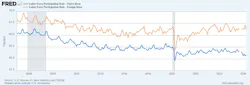
Despite making up only around 15 percent of the U.S. population, immigrants compose about 19 percent of the labor force, according to Pew.
The Manufacturers Alliance’s report, “Impact of foreign-born workers on manufacturing,” dives deeper into the stats. According to the report, from 2020 to 2024, the percentage of foreign-born workers in the machinery manufacturing segment grew from 5 to 6 percent. Also, in 2024, foreign-born workers composed a 19.2 percent share in the durable goods manufacturing segment and a 22.3 percent share in the nondurable goods manufacturing segment — up from 18.5 percent and 21.8 percent, respectively, the previous year.
In an August report, Pew also noted the trend.
“The share of the U.S. workforce made up of unauthorized immigrants is higher than their 4.1 percent share of the total U.S. population. That’s because the unauthorized immigrant population includes relatively few children or elderly adults, groups that tend not to be in the labor force,” Pew states in the report.
Loss of this workforce could be especially acute in manufacturing, where immigrants already play an outsized role.
According to the Federal Reserve Bank in San Francisco, undocumented immigration is correlated with growth in authorized employment, at a scale of about 1-to-1.
“Local immigration slowdowns have reduced employment, especially in construction and manufacturing,” the report states.
Meanwhile, a Goldman Sachs report warns efforts to discourage immigration policies could slow the economy.
“The slower pace of immigration would contribute 30-40 basis points less to potential U.S. GDP growth than the 2023-2024 pace, but it would be just 5 basis points less than the pre-pandemic pace,” it states.
Anxious times for workers and manufacturers
“Some folks you’re hearing in the background are thinking of leaving the country, not because they’re undocumented, but because they’re just unnerved,” said Kevin Kelly, CEO of Emerald Packaging Inc., which makes packaging for produce, such as lettuce and carrots.
Based in Union City, Calif. — considered by Pew to be the state with the biggest population of unauthorized immigrants, with an estimated population of 2.3 million in 2023 — Kelly’s company has a workforce that’s 100 percent legal — but mostly foreign-born.
Jennie Murray, president and CEO of the National Immigration Forum, an advocacy organization, said both documented and undocumented immigrants have felt the pinch, as the government has put restrictions on conditional work authorizations, such as Temporary Protected Status (TPS), that had offered safe haven. Such actions have had a “chilling effect” — even on people who have the right to live and work in the country.
She said documented workers feel pressure to leave “because they’re worried that they have a family member at home that’s maybe unauthorized or is in danger of losing their temporary status, whatever that might be.”
Though his employees are authorized to work and have been verified through onboarding protocols, Kelly said in the fall he was advising employees to keep their paperwork with them, because of the possibility of encounters with enforcement agents who might require it.

“Because it seems like their view of the world is throw everybody who’s brown up against the wall, and ‘let’s figure out whether they’re undocumented or not.’ It’s a frightening prospect,” Kelly said.
By May, through a PR representative, he was expressing another concern — for company President Pallavi Joyappa. Named to her current role in 2023, the Bangalore, India, native has worked for the company in a variety of roles, including as a process control engineer, director of operations and COO, on an H-1B visa — available to highly educated, in-demand professionals — that has been targeted for further restrictions.
In an industry and state so heavily tied to foreign-born workers, Kelly said in the fall he was worried about effects across the supply chain.
“You can’t just run around and throw people out of the country who are necessary to the production of food. The Department of Labor believes that 43 percent of actual crop pickers in the produce industry are undocumented. And there’s raids in the fields,” he said. “It’s going to affect us because it’s going to affect production.”
Over about the past decade, his company, which has a workforce of a couple hundred, perennially has about 20 jobs open.
“And we haven’t been able to fill them as a country. So you’re going to bring more manufacturing here, and where are the skills?” Kelly asked.
“We pay good wages for the area. We match Tesla’s — they’re right down the street. We match their wages because you have to. Someone could make a good living here,” Kelly said.
Then, he dropped an all-too-familiar line:
“But a lot of people don’t want to work in manufacturing anymore.”
Where will future innovations come from?
While technologies can fill some jobs typically identified with undocumented workers, Paul Lavoie, the first-year VP of innovation and applied technology at the University of New Haven, said he’s worried about brain drain of students from institutions like his.
“The skilled labor tends to be here and go through proper channels, and that’s the group that we’re not making it easy for them to come, and we’re scaring them away. But the unskilled, quite frankly, those are the jobs that can be replaced by automation ... by AI,” he said.
After 3.5 years as the chief manufacturing officer for Connecticut, a state defined in part by its ties to the defense industry, Lavoie joined the University of New Haven just as it entered a period of crisis. Of its projected enrollment of 9,000 students, only 6,500 showed up, with many foreign-born students — most from India — staying home due to bureaucratic hurdles put in place to discourage immigration. The university cut 80 staff positions.
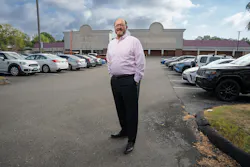
“It’s a combination of, it’s much harder to get here. There’s a fear that when you get here, you start and you go back, you might not be able to get back. And then there’s just, ‘why would I go to America when it’s in its current state?’ ”
Lavoie said he worries home-grown talent alone might not be enough to fill all the roles in society — historically, he said, the country has always benefited from the grit and ingenuity of immigrants.
What happens when the 2,500 students who were expected at the university aren’t around in the next decade or so to guide the next generation of innovations?
“There is never going to be enough people to do the work that needs to be done in America. And, so the only way to do that is through immigration and to have people coming into America to work and to build a better life.
“... I think when we look at workforce development and we look at innovation, I think we can use innovation, we can use robotics, automation, artificial intelligence, additive manufacturing, other areas to help lessen the workforce impact, and we can upskill and reskill people into better jobs. But the thing that really concerns me is the lack of intellectual inventions and intellectual thinking that we no longer have here,” Lavoie said.
Meanwhile, he said, other countries are poised to move forward. He recounted a recent conversation with someone who opened a division in Canada because of concerns about the prospects for foreign-born workers in the U.S.
“He said, ‘I’m shocked at how easy it was for me to establish a business in Canada, and to have these people come to work here,’ ” Lavoie recalled. “And, I said, ‘I’m not shocked, because Canada is not falling asleep on this. Neither is Australia, neither is England, neither is Germany. They are all welcoming all of these students from around the world into their countries.”
In search of balance
There has to be a role for foreign workers in filling manufacturing positions, say both Lavoie and organizations like NAM, which, in a position document, praised Trump’s policies.
“Manufacturers believe that the best, most durable solution to illegal immigration is a legal immigration system that works,” states NAM in a recent report laying out some recommendations.
NAM’s proposals include strengthening the H1-B visa process for workers with highly specialized skill sets — like Emerald Packaging’s Joyappa — and offering pathways for immigrants brought to the U.S. as children. NAM’s recommendations also include a proposal for a guest worker program for hard-to-fill roles, like positions on the shop floor.
“Policymakers must refocus and retool our nation’s immigration system to contribute to the workforce that entrepreneurs and manufacturers actually need to grow the American economy — rules of the road that provide certainty, predictability and workforce stability and a merit-based, employment-driven system that recognizes and maximizes the potential for economic contribution of each immigrant,” NAM states.
After attending an end-of-year celebration, Lavoie said his school, like other universities and high schools, will soon welcome the Class of 2030.
With advances in AI and automation, manufacturing will look a lot different when that group graduates, compared with the shop floor today’s managers first experienced. For those students and employers, immigration policy will be key to solving the workforce challenges of the future.
While the University of New Haven is putting renewed focus on serving American students — it says its goal is to make them “better than ready” to join the workforce — Lavoie said he believes the country should welcome innovation from everywhere.
“A smart policy looks like this: If you come to the U.S. and you get a U.S. education, upon graduation, you should get a green card and a path to citizenship, because we have invested in making you smarter, and we should continue to leverage that by welcoming you here for jobs and careers, so that you can build a life here,” he said. “Now, these are taxpaying citizens that will come into America, buy homes ... have families.”
While he reiterated the importance of protecting the borders, Lavoie expressed sympathy for those who just want to work.
“If you’re coming in here illegally, we should probably find pathways to make it legal. If you can make it from Central America to the Texas border with your life’s possessions in your backpack, and you’re dragging two children with you because you want a better life, maybe we want you here.”
In the land of opportunity
Confer’s offer for immigrants is this: heaven for hell.
About six years ago, he opened an area in the plant you won’t find in many other factories: a peace and prayer room, where employees — he calls them coworkers — can find the sanctuary some of them have long sought.
Employees from hostile countries who have lived through war abroad have become vital members of the workforce, and even friends, according to Confer.
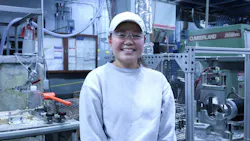
Unlike native-born Americans, who often take a manufacturing job only to leave it, Confer said his foreign-born workers stay and often bring their friends and family. One man, who moved on only because other family members had been settled elsewhere, wrote in a goodbye note, Confer said, “that he believed that it was God that brought us and him together.”
Confer expressed sorrow for employees whose families have been devastated by foreign conflict. One man, he said, returned to the Sudan and risked his life trying to rescue his mother from a war zone.
“He had to leave her over there because he couldn’t find a way to transition her into being an American citizen,” he said.
Such stories make him grateful to be an American, but sad he can’t do more.
“I described the situations from which they came to warm people up to why America matters,” Confer said. “Because it matters to those who were born here, and it matters to those who were not.”
At Emerald Packaging, where about 70 percent of workers are foreign-born, news in May signaled more growth — it’s acquired a second facility, in Santa Ana, Calif., which will eventually mean a workforce increase, from about 250 to over 300.
The grandson of an Irishman who launched his family’s fortunes by laying bricks in New York, Kelly said his workers are carrying out a promise started with America’s founding — that those who work hard can pave a better path for their kids.
“Our grandparents were allowed into the country,” he said. “Who’s going to fill the jobs that are open if we chase 7 million people out of the country? The system itself is broken. There is no system really set up to allow people into the country legally. It’s just cratered.”
Back in the fall, he was looking forward to a “reality-based conversation about why we need workers.”
That might come this year, he said, but seemed more likely in 2028.
“They have the skills, the attitude, really, to do the work. They’re hard workers. ... We have a lot of immigrants in the front office or the factory; immigrants will work their butts off,” he said. “The average American who’s been in the country for generations feels so entitled, it’s ridiculous. Give me an immigrant any day.”
About the Author
Karen Hanna
Senior Staff Reporter
Senior Staff Reporter Karen Hanna covers injection molding, molds and tooling, processors, workforce and other topics, and writes features including In Other Words and Problem Solved for Plastics Machinery & Manufacturing, Plastics Recycling and The Journal of Blow Molding. She has more than 15 years of experience in daily and magazine journalism.