New Shibaura robots can take heavier payloads
By Ron Shinn
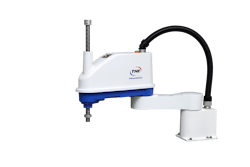
Shibaura Machine has added two models with heavier payloads to its high-speed SCARA robot THE series. Its THE800 and THE1000 robots are especially designed for heavier applications, such as electric vehicle battery manufacturing.
At Automate 2022 in June, the company also unveiled an integrated vibratory feeder system labeled Supata Smart Feeder, developed by Italian manufacturer EPF Plastic, a Shibaura partner. The complete unit consists of a feeding system, a vision system, a robotic handling system and a control system.
The new robots and feeder system are available in North America through TM Robotics. Shibaura Machine was formerly known as Toshiba Machine.
The two new robots have a maximum payload of 44 pounds. Standard cycle time with a 4.4-pound load is 0.41 second for THE800, and 0.44 second for THE1000. Arm length for the THE800 is 31.5 inches (13.8 inches for the first arm and 17.7 inches for the second arm); arm length for the THE1000 is 39.4 inches (21.7 inches and 17.7 inches).
The THE800 has a maximum composite arm speed of 27.6 feet per second and the THE1000 clocks in at 31.2 feet per second.
Previously, the THE600 was the largest in the series with a maximum payload of 26.5 pounds and a reach of 23.6 inches.
Shibaura said the new models are suitable for assembly and inspection of electronic equipment and automotive parts where precision is needed.
All THE series robots use Shibaura’s new TS5000 controller and TP5000 teach pendant. The TS5000 is IIoT ready.
“These accurate, high-performance robots, combined with the next-generation TS5000 and its cutting-edge capabilities, are a formidable automation solution,” said Nigel Smith, managing director of TM Robotics. “These models offer efficiency and quality, all leading to early return on investment.”
The TS5000 uses artificial intelligence (AI) to capture and analyze data on the robot’s performance, Smith said. “This could include vibration analysis, which can determine predictive maintenance suggestions for the robot operator,” he said. “Ultimately, these insights can reduce the amount of unplanned downtime and avoid unanticipated breakdowns.”
The trademarked Supata integrated flexible feeding module is designed to align and feed small parts during assembly or production. It uses gravity and vibration.
The feeder system consists of a vibrating table and hopper that can handle components of different shapes and materials, ranging from 0.4 inch to 9.8 inches in size and 0.9 ounce to 12.3 ounces in weight.
The system comes with a vision system and AI that uses a camera to identify and locate components on the table and then pass coordinates to the Shibaura robot for picking. The company claims its AI can reduce errors and increase productivity up to 20 percent.
The robot can be a six-axis, SCARA or collaborative robot, depending on the picking requirement.
The Supata’s control and monitoring system allows remote connection. The company said the system is well suited to produce small batches and make frequent changes.
Shibaura said the Supata system is available in different sizes and designs, including as a fixed structure or with a mobile chassis.
Contact:
TM Robotics Inc., Elk Grove Village, Ill., 847-709-7308, www.tmrobotics.com
Ron Shinn, editor
About the Author
Ron Shinn
Editor
Editor Ron Shinn is a co-founder of Plastics Machinery & Manufacturing and has been covering the plastics industry for more than 35 years. He leads the editorial team, directs coverage and sets the editorial calendar. He also writes features, including the Talking Points column and On the Factory Floor, and covers recycling and sustainability for PMM and Plastics Recycling.