Realtime Robotics unveils RapidPlan software
By Bruce Geiselman
A new software package from Realtime Robotics helps manufacturers streamline programming and deployment of robots in complex cells, such as those involving multiple robots working in collaboration where their paths of operation might cross.
In an industrial setting, each robot needs a complex motion path for each task that identifies a string of points in space. Ensuring these robots are programmed to work harmoniously can take weeks to months of engineering, according to Realtime Robotics.
The RapidPlan software autonomously creates and choreographs all robot movements and removes the need for brand-specific programming. The software allows users, working with touch screens, to simply click on robots and target points to visualize tasks, according to the company.
The software can run simulations prior to robot deployment. It ensures that robots avoid collisions even in changing circumstances, such as changes in geometry or different locations. RapidPlan adapts to changing environments using information from PLCs or dedicated 3D sensors.
“We specifically designed RapidPlan to deliver an accurate simulation of robot task planning, making it easy to program models and use them directly on the factory floor, but did so in a way that streamlines the process and made the technology easy to use for all,” George Konidaris, co-founder and chief roboticist of Realtime Robotics, said in a press release.
Bin-picking operations where multiple robots operate near each other traditionally have been challenging. RapidPlan software ensures two or more robot arms don’t enter the same space simultaneously, and robot space reservations are released in real time as soon as one robot moves to another location, dramatically improving cycle time or other parameters that users prioritize.
Realtime Robotics demonstrated its new software at Automate 2022 in June in Detroit, working with robots from Mitsubishi Electric Automation Inc., Vernon Hills, Ill., and Kawasaki Robotics Inc., Wixom, Mich., at the manufacturers’ booths.
At the Mitsubishi booth, a demonstration cell featured three robots. An RV-7FRL and an RV-8CRL moved to various target points, and an Assista collaborative robot moved to inspect various points in the work cell. Attendees, using a touch screen, could tap to modify the target allocation and add and remove targets. They also could start, stop and reset all or individual robots. Meanwhile, RapidPlan ensured the robots continued to operate smoothly without any reprogramming or motion plan validation (having to run a simulation before allowing real operations to begin).
“The time spent programming and re-programming industrial robots is typically recognized as a task that can capture far too much of an engineer’s time,” Realtime Robotics CEO Peter Howard said in a statement.
Working with Mitsubishi Electric helped Realtime better understand how streamlining the programming process could be a “massive improvement for manufacturers,” he said.
“Realtime Robotics’ technology has the ability to speed deployment, operations and production for manufacturers, helping to improve their cost structures and time to market,” said Patrick Varley, product marketing manager for mechatronics at Mitsubishi Electric Automation.
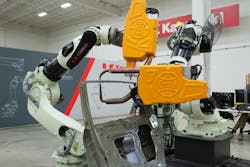
At Kawasaki’s booth, RapidPlan was integrated with two BX100N Kawasaki robots that simulated the welding of a car door using ARO 3G modular spot-welding guns.
RapidPlan is compatible with engineering workstations, field laptops and industrial PCs, which allows customers the option to use their hardware of choice.
Contact:
Realtime Robotics Inc., Boston, 617-302-6330, https://rtr.ai/
About the Author
Bruce Geiselman
Lead Reporter
Senior Reporter Bruce Geiselman covers plastics processing technologies and end markets including automotive and packaging. He also writes features, including In Other Words and Problem Solved, for Plastics Machinery & Manufacturing and The Journal of Blow Molding. He has decades of experience in daily and magazine journalism, including eight years at PMM, and is the recipient of a Jesse H. Neal Award, among other recognitions.