Injection molding innovators: New machines push the boundaries of precision, efficiency and accessibility
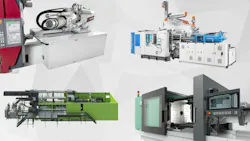
If you've been following the injection molding equipment market since K 2025, you've noticed a few clear themes: all-electric is ascendant, energy savings are now table stakes rather than a selling point, and machine makers are targeting everything from microfluidic chips to automotive structural components with purpose-built solutions.
Toss in a benchtop press that fits under a Christmas tree and a process that lets you skip the compounder entirely, and you have a busy period worth catching up on.
Here's a rundown of the most notable injection molding machinery stories we've published recently.
Going electric for energy savings
The shift to all-electric presses continued to accelerate, with several major OEMs entering or expanding their electric lineups.
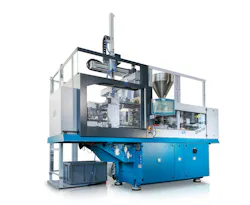
Dr. Boy made perhaps the biggest splash, introducing its first-ever all-electric injection molding machines at K 2025. The new series spans four models — the Boy 35 Electric, 55 Electric, 80 Electric and 100 Electric — with clamping forces ranging from about 39 tons to 102 tons.
All feature electromechanical drives for injection, dosing and ejection, along with a redesigned injection unit with patented back pressure measurement. The machines have notably compact footprints — the Boy 35 Electric takes up less than 24 square feet — and integrate seamlessly with Dr. Boy's LR 5 linear robot through a shared control and alarm system.
The company also debuted the Boy 20 E Pro, a hybrid successor to its long-running Boy 22 A Pro that uses modern servo-drive technology to cut energy use while maintaining the same performance. More than 25,000 of the Boy 22 series have been installed around the world since 1968, so the successor has a lot to live up to.
Read Ron Shinn's story: Dr. Boy introduces all-electric injection molding machines at K 2025
Fanuc, whose Roboshot presses are sold in the U.S. exclusively through Milacron, also debuted new all-electric models at K 2025.
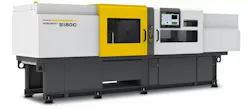
The Roboshot S180C and S350C — designated S200C and S380C in North America to reflect clamping forces in short tons — feature a redesigned clamping unit with more clamping stroke and the ability to accommodate larger molds than conventional presses.
The presses are engineered to reduce energy consumption by 50 to 80 percent compared with hydraulic machines, and can run cycles 5 percent to 50 percent faster.
AI-powered process controls alert operators to potential problems before they occur, and the Roboshot-Linki2 IoT platform enables remote monitoring of up to 1,000 machines simultaneously. With no oil required, they're well-suited for clean rooms and sustainable biopolymer applications.
Read Karen Hanna's story: All-electric Roboshot injection molding machines save energy
Arburg goes mainstream — without compromising on quality
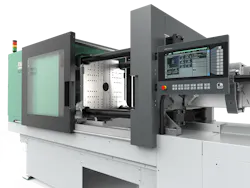
Arburg, long known for precision machines at the higher end of the price spectrum, used K 2025 to make a strategic move toward a broader customer base. The new Allrounder Trend series — available in four sizes with clamping forces from 56 to 225 tons — is designed for standard applications, promises four-week delivery and is aimed at markets where Asian competitors have had a pricing advantage. Managing director of technology Guido Frohnhaus described the line's Gestica Lite controller as a variant of Arburg's high-end Gestica system. The Trend line replaces the Golden Electric series.
Arburg also introduced a new vertical model, the Allrounder 475 V, targeting e-mobility, electronics and medical parts production. With servo hydraulics, it uses 60 percent less energy than conventional vertical presses. New digital tools at the show included MoldlifeAssist for mold monitoring and preventive maintenance planning, and a Virtual Control app that lets engineers optimize cycle times using a virtual twin of the control system.
Read Ron Shinn's story: Arburg debuts cost-effective Trend line, adds to Allrounder series
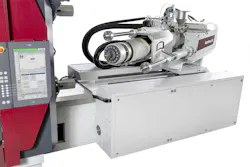
Wittmann redesigns the MacroPower, adds the EcoPrimus
Wittmann Group came to K 2025 with two notable presses. The updated MacroPower servo-hydraulic machine — available on models from 440 to 661 tons of clamping force — now features a pivoting injection unit that swings out for faster, easier screw changes. The one-piece machine body simplifies maintenance, and the press includes a patented swivel locking system, lateral mold insertion through virtually tie-bar-less access, and an energy-recovery system as standard equipment. Wittmann's Drive-on-Demand technology reduces energy consumption by up to 40 percent by eliminating idle current demands and cutting cooling costs.
The companion EcoPrimus, a new all-electric press aimed at mainstream applications, made its debut at the show with 110 tons of clamping force. Wittmann positioned it as a good price-to-performance option available for quick delivery.
Read Ron Shinn's story: Wittmann updates MacroPower press with pivoting injection unit
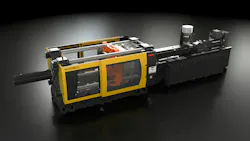
Husky's Hylectric gets a major upgrade
Husky Technologies' Hylectric line — designed for industrial pails, thin-walled food containers, closures and medical devices — has moved to the Hylectric6 platform, featuring optimized feedscrews for better performance and higher throughput. The new machines are connected to Husky's Advantage+Elite 24/7 proactive monitoring system, which tracks more than 70 new packaging performance parameters in real time. The goal is to give operators proactive insights before problems become downtime.
Read Karen Hanna's story: Husky's latest Hylectric offers multiple upgrades
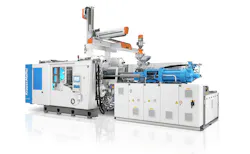
KraussMaffei cuts material costs with in-line fiber compounding
One of the more disruptive process introductions at K 2025 came from KraussMaffei, whose Chopped Fiber Processing technology doses polypropylene pellets and glass fibers directly into the injection molding machine — no pre-compounding of long glass fiber granulate required. CEO Jörg Stech said the process can save processors up to 30 percent in material costs. It also lets processors develop their own formulations and build in-house material expertise.
The key is a patented screw geometry that keeps glass fibers long, homogenizes the melt without forming fiber clusters and orients fibers perpendicular to the melt flow for better dispersion. At K, KraussMaffei demonstrated CFP on a GX 650-4300 press, producing an automotive tailgate component with 3D geometry that was assembly-ready straight off the press. The CFP unit can be ordered on new KraussMaffei machines or retrofitted onto existing standard models, with an estimated payback period of less than one year.
Read Ron Shinn's story: KraussMaffei process doses glass fibers directly into injection molding machine
Micro molding gets more capable
Two stories highlight what's happening at the precision end of the market.
Yizumi debuted the FF30M all-electric micro injection press at K 2025, where it produced microfluidic chips — Labs-on-a-Chip — featuring a lattice of circles just 0.08mm in diameter with a minimum spacing of 0.17mm.
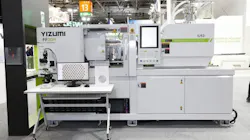
The machine is built for clean room environments and features double-ball screw injection technology, Smart Direct Control (SDC) technology, a separate support structure to prevent thermal deformation and response times of 0.125 millisecond.
While medical is the primary target market, it's available in customizable configurations for food, electronics and other precision sectors.
Read Ron Shinn's story: Yizumi FF30M injection molds micro parts
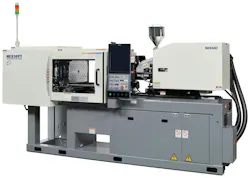
Nissei meanwhile has upgraded the controller on its NEX30V-1EN1 micro molding press, adding its new Tact5 system with full Industry 4.0 capabilities. The all-electric press has 33 tons of clamping force and a 14mm screw diameter. The Tact5 controller enables IoT connectivity through Nissei's N-constellation package, which turns the press into a network hub integrating auxiliary equipment into a smart factory ecosystem.
Nissei also introduced a concept press, the Nova Canbio110T-H320 servo-hydraulic model, designed for thick-wall containers using recycled PETG and capable of running up to 30 percent regrind with a new standard screw.
Read Ron Shinn's story: Nissei upgrades controller on micro molding machine
The small press worth taking seriously
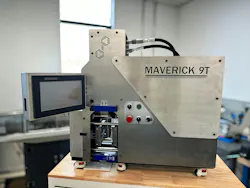
Not every story is about massive clamping forces or K-show debuts. Polymer Dynamics' Maverick 9T is a fully automatic, servo-driven hydraulic benchtop injection molder that made its debut at MD&M West in Anaheim, Calif., in February.
At 36 inches long, 13 inches wide and 32 inches tall — and 375 pounds — it genuinely fits on a workbench. It has 9 tons of clamping force, three-zone temperature control, supports standard resins and 3D-printed molds, and starts at $58,670.
VP of engineering Brendan O'Neill said the machine takes about four hours to learn, is aimed at newcomers to injection molding and can run production volumes up to roughly 500,000 parts per year. A two-press Wingman Station configuration is available for overmolding applications. The company, which also offers design-for-manufacturing consulting and mold tooling services, expects to ship about 20 units this year.
Read Ron Shinn's story: Benchtop injection molding machine offers full production capability
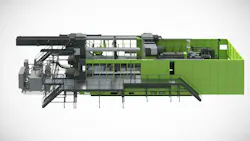
Engel rethinks the Duo combi M for in-mold PU coating
For processors who want to eliminate downstream painting and coating operations, Engel has modified its Duo combi M two-platen machine to better accommodate its Clearmelt system, which applies high-quality, scratch-resistant polyurethane surface layers directly to plastic parts — a capability particularly in demand for automotive interior components.
The key change: the standard injection unit on the fixed-platen side has been removed, freeing up the space needed for PU processing hardware. The thermoplastic component is injected from the moving side of the machine instead. The result is that the PU technology sits much closer to the mold, shortening feed lines and enabling faster color changes and more flexible use of color units.
The overall footprint shrinks by roughly 25 percent compared with a conventional Clearmelt setup, and the system is easier to install, operate and maintain. For shops with existing equipment configured the conventional way, Engel also offers a mirrored version that keeps the injection unit on its customary side. Though optimized for Clearmelt, the modified machines can also run standard injection molding applications. First systems are expected to go into operation this fall.
The Duo combi M series spans a wide range — clamping forces from about 506 tons to about 6,182 tons, with higher tonnages available by special order — so the Clearmelt-ready configuration should be accessible across a broad range of part sizes and production volumes.
Read Karen Hanna's story: Engel modifies Duo combi M for PU coating
The through-line in all of these stories is familiar but still worth stating: injection molding equipment is becoming simultaneously more capable, more energy-efficient and more connected. Whether you're molding microfluidic chips or automotive structural parts, compounding your own reinforced materials, applying in-mold PU coatings or learning to mold for the first time on a benchtop press, the machine options available today are more targeted than they've ever been.