Benchtop injection molding machines bridge transition from concept to production
By Jeff Elliott
When a company needs molded plastic parts before investing in expensive hard tooling, a benchtop plastic injection molding machine (IMM) can provide a practical middle ground between hand-pull molding systems and industrial injection molding equipment that can cost $35,000–$60,000 for even a small-to-mid-sized model.
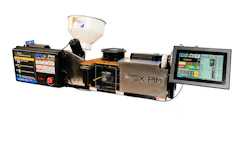
With an approximate footprint of 4 feet by 1 foot, a desktop IMM can be installed on a workbench or table while delivering many of the production capabilities expected from full-scale injection molding equipment. It supports repeatable molding cycles, consistent part quality, automated operation, controlled injection and clamping functions, and the use of production-grade thermoplastic materials and molds.
Benchtop equipment also serves as a practical training platform, helping operators develop a clearer understanding of resin selection, mold procurement, processing parameters, cycle optimization, part quality evaluation and basic troubleshooting.
This makes it an ideal solution for short-run manufacturing, pilot production, product validation and in-house part production without the capital investment, floor space, utility infrastructure or operational complexity of full-size IMMs.
OEMs step into production
For Brian Finch, COO at Brightz, a benchtop IMM was the ideal entry point for bringing some plastic production in-house. Brightz offers LED light kits and accessories, as well as lighting products for games, outdoor use, wearables, cornhole, camping, canopies and more.
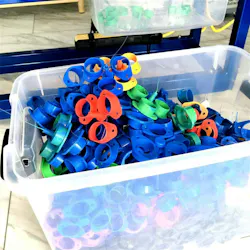
The initial application involved molding plastic clips that could be used to mount LED lights onto bicycle handlebars. The goal was to learn the injection molding process directly, test production assumptions and understand what would be required before making a larger investment.
“We didn’t have a lot of expertise in-house, but we wanted to do it ourselves,” said Finch, who purchased the APSX-PIM, an automatic, heavy-duty desktop IMM for continuous or single-cycle production. “The machine met our requirements for being easy to set up and use by someone with technical experience, even without prior injection molding training. At the same time, it was good enough to support our production needs. For us, it proved to be a strong entry-level machine.”
When WrapOn Tools of Asheboro, N.C., invented a new product for vinyl applicators, the company also decided to manufacture it in-house rather than outsource it.
WrapOn Tools designs, manufactures and distributes products specifically for the vehicle wrap industry. One of its core products is the patent-pending KnifeTucker, a tool designed to help installers tuck vinyl around edges during the finishing stage of a vehicle wrap. The tool replaces the standard clip-on, snap-off blade knives, giving wrap and graphics installers a built-in tucking tool that stays attached to the knife for faster, more precise film installation.
The product began as an idea from inventor Scott Decker, but it required extensive design and development before it was reliable.
Decker initially explored 3D printing, but the process did not deliver parts that were strong enough for the application. Because the tool is used under pressure, the layered structure of a 3D printed part created the risk of snapping or breaking during use. That simply would not work for a tool used near finished vinyl and vehicle surfaces, where a broken piece could scratch the wrap or the car.
Decker experimented with a homemade injection molding setup, using plans from a builder in Switzerland. That early setup proved the concept, but it was only able to produce two or three parts every 10 minutes, which was not enough to keep up with demand.
Compact and easy to use
With no formal manufacturing background, the team began looking for a practical way to move from prototype to production. APSX, a company that provides compact, affordable benchtop IMMs, a desktop CNC Swiss lathe, CNC accessories and wireless CNC control solutions, offered a more accessible path with significantly lower capital investment and a reduced operating burden.
The APSX-PIM measures 43 inches by 10 inches by 15 inches, does not require a water-coolant system and runs on standard wall power. The latest ASPX-PIM, now in its third generation, is automatic, with multi-mode operation, precision sensors, electronic temperature control, injection speed control, delay control between cycles, a touch screen, and an injection performance chart showing pressure and volume over time.
“The machine-control interface is easy to understand and kind of foolproof,” Decker said.
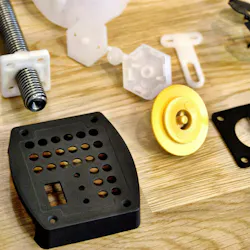
The machine uses aluminum molds produced with standard CNC milling, supports rapid re-machining for dimensional refinements, and can accommodate 3D-printed trial inserts for early-stage validation.
With a properly designed aluminum mold, users can inject and evaluate parts the same day, update the CAD model, re-machine the cavity and return to molding within hours. Mold installation is straightforward, allowing users to produce an initial part shortly after setup.
The APSX-PIM can process a wide range of thermoplastics, including PP, PE, nylon, PC, acetal, ABS and blends that meet its melt-flow guidance.
Because WrapOn Tools already had experience with desktop 3D printers, the idea of using a desktop IMM felt familiar and achievable. The smaller format made the equipment less intimidating and gave Decker and his business partner and equipment operator, Josh Lambert, the confidence they could learn the process.
Once the process was dialed in, Lambert was able to produce a batch of four parts in about 90 seconds. The parts require very little post-production work, allowing them to be boxed and shipped within minutes of coming off the machine.
“To be able to get the precision that we are getting, it is hard to believe we can do that on a desktop machine,” Lambert said.
Today, WrapOn Tools still runs the same APSX-PIM machine it purchased in 2020. The machine is typically used about twice a week, running throughout the day during production. Maintenance has been limited, with one bearing issue attributed to lack of maintenance rather than a machine defect.
The company now produces several KnifeTucker mold variations, including the original model, the KnifeTucker Slim for tucking into tight details and crevices, and versions designed for specific knives.
Filling the gap as production scales
As WrapOn Tools continues to grow, Decker said the company will eventually need larger and more capable equipment for bigger production demands. But the APSX machines filled an essential gap between invention and full-scale manufacturing.
“I just don’t know how else we would have done it,” Decker said.
WrapOn Tools expects to continue to use the APSX-PIM even when the company grows into larger equipment. The benchtop machine will continue to support small runs, material trials and development work.
For companies that need molded parts but are not ready to take on the expense or complexity of a complete plastic injection molding system, benchtop models offer a practical and cost-effective way to test designs, validate production processes, and complete small to mid-level production runs.
During that time, operators can gain experience with the molding process on production-grade equipment and can make better decisions when a part is ready to move from prototype or low-volume production into full-scale manufacturing.
For startups, R&D teams, product design firms, educators and small manufacturers, this combination of affordability, repeatability and accessibility makes benchtop injection molding machines the ideal bridge between concept and production.
Contact:
APSX, Blue Ash, Ohio, 513-716-5992; [email protected]; www.apsx.com
About the Author
Jeff Elliott
Jeff Elliott is a Torrance, Calif.-based technical writer. He has researched and written about industrial technologies and issues for the past 20 years.