Arburg confronts economic challenges
By Karen Hanna
Just a few months into his job, new Arburg CEO Volker Nilles is getting to know employees and customers — and seeing firsthand the challenges the company is confronting. At the company’s Technology Days, he and other officials acknowledged conditions are tight, particularly in Western Europe.
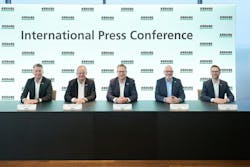
“If we look at the developments in recent years, it is clear that the world has changed significantly – and at a pace that none of us could have imagined just a few years ago,” Nilles said through translators at a press conference March 10, as global news focused its attention on the spreading war on Iran.
The company is putting on hold plans to expand manufacturing in the U.S., citing market volatility and the current, fluid nature of trade agreements, according to Guido Frohnhaus, managing director of technology and engineering. The announcement comes just weeks after the U.S. Supreme Court blocked one set of tariffs on products from overseas, leading President Trump to impose another set of duties. Discussions about possible refunds from the canceled tariffs — levied by Trump under the International Emergency Economic Powers Act — are ongoing.
Tobias Baur, managing director of sales and aftersales, said last year was tough and so far, this year isn't improving.
“We are still in a phase of far-reaching and geopolitically profound developments, but also local political influences that prevent an economic recovery,” he said through a translator.
Competition and offshoring to Asia have hurt manufacturing in Europe, and in Germany, he said, “there is still little innovative strength.”
But, he said, “In the USA, the situation in 2025 was surprisingly better than in the previous year, notwithstanding U.S. customs policy.”
Among the end markets showing growth are the medical and electronics and electrical industries. Meanwhile, the automotive market continues to struggle, according to Baur.
Last year, Arburg cut about 300 jobs from its Lossburg, Germany, headquarters through a voluntary redundancy program and improved partial retirement, said Steffen Kroner, managing director of finance, controlling, IT and global HR. It currently employs around 3,400 employees worldwide, about 2,800 of them in Germany.
As Nilles observed, these are tumultuous times. He said his company is eager to meet the challenge and, with its technologies, work with its customers to move forward.
“Globalization as we knew it has come to an end, even if only temporarily. A triadic world structure has emerged, along with its geopolitical and geo-economic challenges. Changing market requirements, such as faster time to market and severe price pressure, are issues we deal with every day.
“Companies are therefore compelled to face their challenges of increasingly volatile markets and adapt to them in order to remain competitive,” Nilles said.
About the Author
Karen Hanna
Senior Staff Reporter
Senior Staff Reporter Karen Hanna covers injection molding, molds and tooling, processors, workforce and other topics, and writes features including In Other Words and Problem Solved for Plastics Machinery & Manufacturing, Plastics Recycling and The Journal of Blow Molding. She has more than 15 years of experience in daily and magazine journalism.