Purging compound rinses out high-heat resins
Key Highlights
- Purging compounds like Dyna-Purge E4 significantly reduce changeover times, saving valuable production minutes.
- The new formula is tailored for high-temperature resins such as PEEK, PEI, and PPS, processing up to 715°F efficiently.
- Tech-Way Industries has used purging compounds for over 20 years, emphasizing efficiency and material compatibility in complex molding tasks.
- Using specialized purging compounds decreases scrap and off-gassing, leading to cleaner operations and better part quality.
- The evolution of purging compounds aims to use less material while delivering superior cleaning performance, making molders more competitive.

Problem: Short runs and expensive materials could add up to costly changeovers for one custom molding shop.
Solution: Purging compounds — including a new formula for high-temperature engineering-grade resins — allow for quick, efficient changeovers.
By Karen Hanna
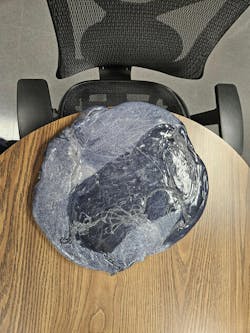
A plastic disc with a swirl of blue shades offers testament to the benefits of an oft-unsung ingredient of any injection molding operation: the purging compounds that clean out the machines and allow for easy color changes from one batch to the next.
Tech-Way Industries, Franklin, Ohio, has one such pancake — a slab of garbled colors that recalls a time when an employee kept a press running, hoping to eventually just burn through one batch of color and replace it with another.
What a waste.
“It’s kind of psychedelic, as you’re trying to get the color out and everything. ... The guy was trying to do it without using any purging agent, and it was still blowing weird colors out,” VP Brian Kress said.
According to Tech-Way President Ken Parker, the company has seen good results using Dyna-Purge’s newest compound, the E4, which has been tailored to purge engineering resins.
“Going back to my years of experience — I’ve been here full time for 50 years now — I have always used purging compound, because I’ve seen people try to do it with one material and then the next material,” Parker said. “You always get some sort of incompatibility, particularly if you’re switching resin types.”
Warming up to purging compounds
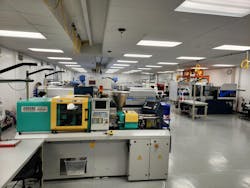
Since Parker’s father and three others formed Tech-Way in 1964, the plant has grown to about 70 employees, operating three shifts a day, five days a week. It has about 50 presses, along with an in-house tool shop and equipment to perform a variety of downstream, value-added tasks.
Speaking just before Thanksgiving, Parker was looking forward to seeing an upswing in business for the custom mold shop.
“We have confidence that things will pick up. We’ve seen signs in tooling, increased quoting ... [which] is usually a sign of an economy that will start to pick up in about six months,” he said in an email following a video discussion about E4.
Tech-Way thrives on jobs other molders don’t want or aren’t capable of handling.
Extreme tolerances and temperatures are part of everyday life.
“From propylenes, ABS, polycarbonates, if you can name a plastic material, we’ve probably run it here,” Parker said. “In the clean room, we get up into the higher temperatures. We’ll get glass-filled ... Ultems, other glass-filled materials, polyurethane, 50 percent glass-filled.”
It’s used Dyna-Purge compounds for about 20 years, and the latest product iteration targets in particular the work the molding shop does.
Dyna-Purge’s legacy E2 compound, which Tech-Way has used, can create smoke and off-gassing when added to machines that have processed high-temperature resins, so Dyna-Purge worked to do better, said Ken Shuman, president of Shuman Plastics, which owns the brand.
Based on E2, the new E4 compound is designed for more efficient handling of resins, like polyetheretherketone (PEEK), polyetherimide (PEI), polyphenylene sulfide (PPS), polyphthalamide (PPA) and polysulfone (PSU), that are processed at temperatures ranging up to 715 degrees Fahrenheit.
Even for a guy who sells purging compound, Shuman said he realizes ultimate proof of its improvement is that his customers don’t have to use as much of it as the product evolves.
“Oddly, that’s kind of the business we’re in. I know a lot of companies show up, and they’re trying to sell more units to the customers. We’re actually showing up trying to sell less units to a customer, but having it work better. It’s kind of paradoxical in a way, but that’s really the game, is to make our customers more competitive,” Shuman said.
Proving its mettle
Frequent changeovers and part complexity are among the challenges that define work at Tech-Way.
“Some of these parts are extremely small — I’m talking maybe an eighth of an inch high. We actually make one part which has five-thousandths (of an inch) holes, meaning up to 20 thousandths holes in them. [The holes] are smaller than fleas,” Parker said of the pits in the part for medical applications.
“These are parts that go up inside the body in heart procedures,” Kress said.
With parts that sophisticated and niche, typical volumes are small. Parker said a job that lasts a week is a big order.
Being able to quickly prepare a machine for the next batch puts emphasis on the choices the company makes when it comes to purging.
Some extrusion plants and molders still try to clean out their machines using either virgin resin or regrind, trying to force through enough neutral-colored material to allow for a new batch of parts that represent a different color or material than the last.
That’s not the way at Tech-Way, because, according to company officials and Shuman, it takes a lot of time and uses material that might otherwise be recycled or go into parts that can be sold.
“You may get some benefit, not none, but it is never, never designed to be really effective and efficient as an intermediary to clean between resins and colors, and to really scrub and scour screws and barrels and get yourself set to optimize production,” Shuman said.
“So, yeah, that’s really what it comes down to is you [have to] use the right tool for the job, and then in any tool room, if a guy went at a tool with the wrong bit or the wrong ratchet, they’d punch him. They’re not going to let him get away with that. But, somehow, you can get away with pouring anything you want down the throat of a machine and calling yourself a purging expert,” he said.
As Dyna-Purge prepared to release E4 around the time of the K show, Tech-Way was ready to test for itself the benefits of the newest offering.
To determine what’s most appropriate for high-temperature applications, clean-room supervisor Alex Rodriguez ran experiments pitting the newest compound against E2. The goal was to change over from colored parts to clear parts using the least amount of material in the fastest time.
“Alex kind of went through the scientific method and did a lot of testing in a couple of different machines,” Kress said.
In a video interview, Rodriguez displayed graphs showing what he had learned.
“It took about over three minutes just to get that barrel, that screw clean with the E2 purge; using the E4, it was two and a half minutes,” Rodriguez said.
Real-world results were even more dramatic — with E4 requiring half as much time to purge out one color to start a new color.
And, Rodriguez said, the amount of E4 required to achieve those results in that time is less than what’s required when using E2.
“You’ll get bad parts or scrap parts with the E2, 0.29 pounds. I weigh everything. E4, 0.15 [pound], so same thing, less scrap. As soon as that production started, just less bad parts, and then the time it took, it was less, too,” he said.
With results like that, Tech-Way will be stocking up.
As it runs through its supply of E2, Kress said the company would order more of the new product, to match the needs of its high-temperature applications in areas of the plant outside its clean-room areas, where it initially began using E4.
“We will be using them more and more out in the main plant, because the molding division is divided into two: We’ve got clean-room molding, and then we’ve got molding for everything else. We had a lot of E2 and other purging compounds down there, and as we’re using them up, we’ll be replacing the ones for high-temperature stuff,” he said.
One strategy that’s not an option?
Not purging.
Parker’s multi-colored puck of plastic gunk explains why.
“That was expensive polycarbonate,” he said.
Contact:
Dyna-Purge Division of Shuman Plastics Inc., Depew, N.Y., 716-685-2121, https://dynapurge.com
About the Author
Karen Hanna
Senior Staff Reporter
Senior Staff Reporter Karen Hanna covers injection molding, molds and tooling, processors, workforce and other topics, and writes features including In Other Words and Problem Solved for Plastics Machinery & Manufacturing, Plastics Recycling and The Journal of Blow Molding. She has more than 15 years of experience in daily and magazine journalism.