Gear maker finds reliability, traceability with Milacron, Fanuc
Problem: Tight tolerances and expensive resins put pressure on a molder to maintain part quality.
Solution: The molder has adapted to new technologies from Milacron and Fanuc, which have demonstrated their ability to keep parts within spec.
By Karen Hanna
Customers in the medical industry need more than reassurances; they need proof.
“We have medical [customers], they want to see the latest and greatest technology, that we’re keeping our stable fresh with the latest stuff,” said Peter Fongemie, assistant molding manager at precision molder ABA-PGT, which this year added its first 330-ton Roboshot press and recently installed three new 55-ton injection molding machines (IMMs) from Milacron.
Known for the gears it makes for the medical industry, as well as for customers in the automotive industry and others that deal with irrigation systems, ABA-PGT was the first company in North America to mold a nylon gear, according to President Bob Hazelton.
Based in Manchester, Conn., the 81-year-old company trades in precision parts with extremely tight tolerances, down to thousandths of an inch. It works with very expensive resins, including polyetheretherketone (PEEK), so it requires technologies that minimize scrap. It makes its own molds.
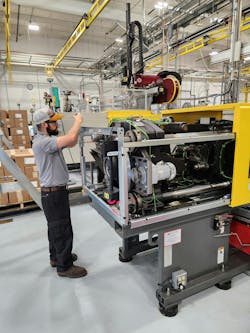
It’s organized as an Employee Stock Ownership Plan (ESOP) company, so all of its approximately 125 employees have a keen interest in its success and quality, according to Hazelton, who’s also the trustee for the ESOP.
With its reputation for quality, he said, it’s been “growing like crazy” over about the past decade.
“We built the company, and we maintain the company on quality and precision. That’s at the foremost importance here in the building, so we have to have quality tool building and quality machines,” he said.
Since buying its first Roboshot in 1994, the company has filled its mold shops exclusively with machines from Milacron and Fanuc, which in the U.S. offers its presses exclusively through a partnership with Milacron. The molder is committed to regularly replacing its older machines.
“We are a world-renowned gear molder. That’s what we do is gears, and we specialize in it, and people come to us for the gears that no one else can make. So we’ve got to have that accuracy, and that’s why we run with the Milacrons,” Fongemie said.
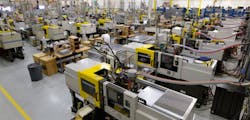
As of early fall 2025, ABA-PGT was running 48 IMMs at its plant in Manchester, along with 16 at a facility in Vernon, Conn., about 10 minutes away. There, Fongemie said, the molder operates “lights-out at night with no one in the building.”
“It runs automatic, and we only have people there during the day,” he said.
With its partnership with Fanuc — a Japanese company that has long relied on automation and lights-out manufacturing — Milacron can support molders like ABA-PGT that are seeking to take a similar approach, said Kent Royer Sr., strategic marketing manager for Roboshot for Milacron.
"We continue advancing the capabilities for running lights-out, as ABA-PGT knows. So, for example, if a device — it doesn't even have to be the molding machine, it could be a conveyor, could be a box collection bin — but if those devices stop to function, we can alert the machine to stop production and go into what we call shutdown mode, so it will actually back up the injection unit, it will auto-purge, and then it can actually shut [off] the heat on the barrel, so you're not degrading the material,” Royer said.
The lights-out approach at Vernon saves customers money, ABA-PGT says on its website.
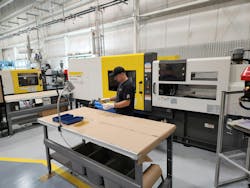
“These standardized machines run 24/7 and require only one staffed shift during the day. This facility allows us to offer clients more cost-effective solutions for the same standardized, high-quality parts we have always been known to deliver,” the website states.
The company also touts the convenience of having redundancy across its IMM lines, as well as the precision, repeatability and quality the all-electric machines offer.
Fongemie noted the presses’ energy efficiency, stability, accuracy and ease of use.
He also is proud of the company’s cleanliness.
“Some people come in and say it’s cleaner than a clean room,” he said.
In addition to its conventional horizontal injection molding services, ABA-PGT offers two-shot molding and automated insert molding.
ABA-PGT has had one of the longest relationships with Milacron of any molder in the Northeast, Royer said. He’s worked for Milacron for more than 40 years — a tenure that predates Milacron’s relationship with ABA-PGT by just about a decade.
Royer noted that Milacron understands the demands of molding for the medical industry.
“When you deal with medical, they do not want to have any downtime, and if they have to change any component, frequently they may have to re-qualify or document changes to the machine, and they want to avoid that,” Royer said.
To deal with demanding resins, including corrosive ones, Milacron offers custom screws made with materials, such as tungsten carbide, robust enough to meet the challenge.
“That’s why Milacron’s been a very good partner to ABA-PGT because we do offer those packages,” Royer said.
A strategy of sticking with Milacrons and Fanucs means there’s less of a learning curve for employees operating new machines.
At the same time, ABA-PGT can make its case to potential customers that it’s keeping up with the times.
"One of our favorite things about the machines is the accuracy. But it’s also their AI ... their mold protection in the ejectors and mold open and mold closed. It allows us to run feeling comfortable that if something binds up, we’re going to stop it without doing damage to the tool. It’s really a saver. As long as it’s set right, it works. ...” Fongemie said. “It saved us a lot of money on steel, repair stuff.”
While the company is careful with its money, Hazelton said investment in new equipment just makes sense.
“They come up with new software and technology and stuff like that, so the machine is smart enough where it knows if it’s about to produce a bad part, to some degree, and you want to take advantage of that software,” he said.
As it installs new machines and replaces old ones, ABA-PGT draws on Milacron employees’ expertise to bring everyone up to speed.
“You can go to a new one that just comes in and the software, if it’s updated, may be a little bit different, but for the most part, it’s pretty close; it makes it a lot easier. ... There’s a lot more features; you can monitor more stuff,” Fongemie said.
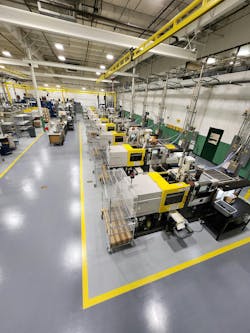
However, that doesn’t mean that the old machines are failing. Actually, they’re still chugging along just fine.
“Once you set it up, you don’t have to touch it. You never have to come back and make adjustments. It just continues, day in, day out, repeats,” Royer said. “From Day 1 to 30 years later, it will still give you that same position repeatability.”
While it needs to update its machines to demonstrate to some customers it has the capabilities to perform even the most demanding applications, ABA-PGT still leans on some of its workhorses, explained Fongemie and Nick Dearent, a sales engineer for Milacron in New England.
Rigorous adherence to preventive maintenance (PM) keeps them humming.
“We take care of the machines. We do our PMs when we’re supposed to, and they run forever. We had one — what was the cycles we had on it, Nick? 65 million-something?” Fongemie asked.
“I think you were upwards of 70 million, above 70 million cycles,” Dearent responded. “That just goes to show you the repeatability and reliability of these machines.”
Now around 15 years old, “it’s still making parts,” Dearent said of the machine.
Even though the machines it’s replacing still work, ABA-PGT has customers to impress by investing in the future.
“It’s the technology on our end, more so than the machine not lasting. The machine will run forever. I could have kept the machines we had, and they’d still be running. But our goal is to get the latest and greatest technology,” Fongemie said.
About the Author
Karen Hanna
Senior Staff Reporter
Former Senior Staff Reporter Karen Hanna covered injection molding, molds and tooling, processors, workforce and other topics, and features including In Other Words and Problem Solved for Plastics Machinery & Manufacturing, Plastics Recycling and The Journal of Blow Molding.