Florida toolmaker blends metal and plastic to perfect dog-grooming tool
Key Highlights
- Southpointe Precision's ability to work with both metals and plastics enabled the production of the Coat Tender dog grooming tool.
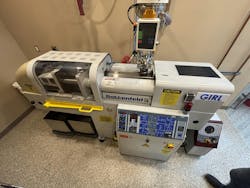
- The company relies on Wittmann injection molding machines, including a 1990s-era Battenfeld model and newer Wittmann presses.
- Developing the Coat Tender took approximately eight months of trial and error.
- The small team produces around 3,000 units monthly, with capacity to increase to 5,000.
Problem: A device for grooming dogs required expertise in both metals and plastics to manufacture.
Solution: A manufacturer that relies on Wittmann technologies has fine-tuned the process to get the grooming accessory to market.
By Karen Hanna
Working with both metal and plastic can be a hairy situation.
Robert and Kelly Irion, co-owners of Southpointe Precision LLC, know that firsthand. Their paws are all over a product that brings together both materials.
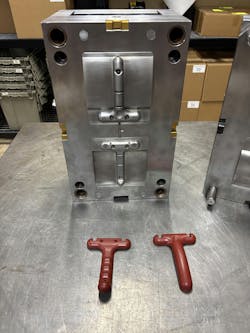
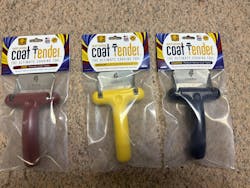
The couple, who run tool-and-die shop in Florida, helped a dog groomer bring her dream to market — a special carding tool for removing loose top and undercoat fur from shedding breeds across a range of characteristics, from pugs to Labrador retrievers. The tool, known as the Coat Tender, has stainless steel teeth and an acrylonitrile butadiene styrene (ABS) handle. A Wittmann injection molding machine (IMM) is key to the application.
“The patent on it is basically the fact that it has a spring action, with a spring in it. It’s the geometry of all the bends, that took forever to figure out,” Robert said. “The complicated part is actually more so the metal. ... There’s lots of products where the plastics is the nightmare, but this one, not as much.”
However, Robert’s portfolio of tricks — especially his ability to work with both plastics and metals — was what allowed the Coat Tender to take shape, after famed dog groomer Jodi Murphy had worked on the idea for more than a decade.
“I was fortunate to connect with Robert,” Murphy said in a press release provided by Wittmann. “His attention to detail is like no other — he’s taken this tool and made it better than I ever could have imagined. His team is equally impressive. The quality control at Southpointe Precision is phenomenal, and their commitment to excellence has made all the difference.”
Injection molding machine is a cut above
Established in 2000 as a production surface grinding facility, Southpointe has just eight employees, including the Irions, but Robert — who is one of five machine operators — puts no limits on the kinds of jobs they’ll take on.
“I don’t question either my ability to make a tool or our equipment,” Robert said in the press release. “It’s more about gaining the trust of customers because we’re small. They have to have the confidence in you coming in the door. Are we capable of making a given product? I’ve never said no to anybody. I tell them I’m capable of making anything.”
But, until buying his first IMM, a 1990s-era machine, in 2011, he had no intention of working with plastics.
“A customer I built a mold for decided that we needed to run the mold, too,” he said. “And, begrudgingly, I’m like, ‘fine,’ so I found the cheapest mold press I could find on eBay. I think I spent $5,000 on an old Battenfeld 250-plus machine. That machine is still running today. It has run ... millions and millions of parts, off of a 1990s machine.”
Battenfeld became part of Wittmann after manufacturing that IMM, which now churns out 1.5 million validated medical parts every year for Southpointe.
Today, Southpointe’s stable of five IMMs includes four machines from that Wittman-Battenfeld lineage — two hydraulic Plus 250s, a hydraulic HM 110 and a servo-hydraulic SmartPower 110.
“We were so impressed with the quality and longevity of this Wittmann machine that we have added three additional Wittmann mold presses to our molding operations,” Robert said.
The company also has three Drymax E30-70 dryers, two Dosimax MCBalance feeders, three Feedmax S3 net loaders, a Tempro basic C200 temperature controller and a WP80 Sprue Picker, all from Wittmann. The IMMs have clamping forces ranging from 28 to 120 tons and process about 60,000 pounds of material annually.
Robert said Wittmann provides very good service, and its machines are easy to use and flexible.
“It’s very intuitive, and the fact that we can make it do what we want it to do, when we want it to do it, however I want to do it, that’s the appeal,” he said.
Kelly lauded the presses’ reliability.
“We’ve had a couple issues lately where we’re trying to keep parts consistent, but both those products were run on the non-Wittmann machine. We tend to not have any issues when we run it on the Wittmann,” she said.
Collaring perfection in plastic and metal tool
Based in Fort Myers, where Southpointe is located, Murphy found the shop through a web search. She approached the company originally hoping it could make handles for the Coat Tender.
“She had some drawings made from a shop that did it originally,” Robert said in the press release. “We had to modify it from there. Originally she wanted us to mold the ABS handle. We built just a one-cavity sample tool, then Jodi came back after we got that done and said nobody’s capable of making the metal, either — so we ended up with the entire project.”
With a small staff, Southpointe focuses on low volumes — quantities of around 20,000 parts, or even fewer — and prototypes. Robert and four other operators run machines for 1 to 1.5 shifts five days a week, according to the Wittmann press release.
Southpointe’s versatility set them apart.
“We have customers from Alaska, up in New England, California. I don’t know how these people found me. I do zero marketing. Like none,” Robert said.
The shop has a clean room, so as Robert explained, “we’ll make anything from a part for John Deere to something they use in an operating room.”
About half the company’s customers come to it with jobs dealing with metal parts, like the Coat Tender’s blade.
“The metal components are by far the hardest,” Robert said, “because you’re basically making a clipper blade, something that looks like a blade that would go in a clipper, but you’re doing it out of a soft material, so you can’t do it how they would traditionally do a clipper blade, just due to the fact it would roll a burr, or it would deform the edge. The geometry actually matters, because of the way it catches the hair to remove it. You’re not trying to cut the hair; you’re trying to collect it.”
Work on developing a process to produce the Coat Tender consumed about eight months, and “took a lot of trial and error to get it right,” Robert said.
“We developed a process to cut the blades, make the tension brackets and assemble/package the part completely,” he said.
For a small company, the Coat Tender represents a big opportunity. Southpointe produces 3,000 Coat Tenders, available in three colors for breeds with three different coat types every month and would be able to produce 5,000 a month, Robert said.
The job of manufacturing them has required Southpointe to invest in some additional EDMs, for metal cutting.
Available at www.coattender.com, as well as through a couple distributors in the U.S., Europe and Asia, the Coat Tender promotes healthier skin and coat, and using it leaves dogs looking their best.
The website touts another benefit — it’s made in the USA.
As someone who’s not a dog lover, Robert admitted he can’t relate to the dog owners who might buy the Coat Tender.
But he appreciates their business.
“We put in equipment just for this, to help capacity. We have people that are pretty much full time just working on dog combs all day, every day. They print me out little stickers that go on the wall to say, ‘I love dogs,’ just to mess with me,” he said.
In October, more than year since the Coat Tender hit the market, Kelly said Southpointe has continued to fine-tune the manufacturing process and now has a “solid procedure in place.”
“It’s nice for us to be able to utilize the metal and the plastics together,” she said.
About the Author
Karen Hanna
Senior Staff Reporter
Senior Staff Reporter Karen Hanna covers injection molding, molds and tooling, processors, workforce and other topics, and writes features including In Other Words and Problem Solved for Plastics Machinery & Manufacturing, Plastics Recycling and The Journal of Blow Molding. She has more than 15 years of experience in daily and magazine journalism.