Patent Report: Invention removes air from injection molds
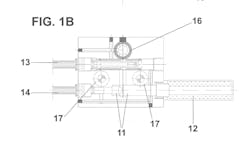
Mold suction device. A Spanish company received a patent for a device and process that effectively remove unwanted air from an injection mold.
When the plastic melt is injected into a mold cavity, the melt applies pressure to the air that is in the cavity, compressing it and forcing it to exit through the ejectors and other mechanisms designed for that purpose, according to the patent issued to Comercial de Utiles y Moldes S.A., Sant Just Desvern, Spain. However, the pressure on the injected plastic produces internal stresses, which can negatively affect the quality of the part.
Some existing solutions use porous inserts to allow the air to escape. A disadvantage is that the inserts are very easily clogged. Additionally, air bubbles can still be trapped in the molded parts, which can affect dimensional stability and mechanical resistance and cause surface imperfections and deformations.
Other existing systems use suction to remove air from the mold prior to injection. However, “if the mold is not completely sealed during the brief time that the injection signal has been given until the plastic actually enters the cavity, the atmospheric pressure tries to balance the pressures inside of the mold and part of the efficiency of the vacuum obtained is lost,” the patent states.
The invention has a venturi ejector connected to a valve that creates suction in the mold cavity when the mold is closed. The mold features at least one insert made of a porous material and a second venturi unit in the mold.
The first venturi creates suction until a set vacuum value is reached, at which point the valve closes. From that point on, only the second venturi is suctioning the air from the cavity, through the porous insert. When the plastic starts to enter the cavity, “the volume of air to be suctioned reduces proportionally, which is eliminated by both the power of the venturi suction and its own injection pressure, since the plastic itself acts as a piston compressing the remaining air and increasing its outlet pressure, which means that the efficiency of the system is considerably improved,” the patent states.
Further, the porous insert needs “to be housed in the end of the path of the plastic mass, since it is where the material will be the coldest, and therefore less fluid, all with the purpose of not clogging the micro-pores of the porous material with the injected material,” the patent states.
Patent 11,161,289; issued Nov. 2