Paper-for-plastic swap reduces resin use in containers
By Karen Hanna
For brand owners and manufacturers looking to reduce the use of plastic, mold maker and in-mold-labeling (IML) technology specialist Muller proposes an alternative: Paper.
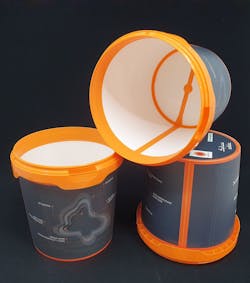
More than 5 years in the making, the company’s Skel-Pac container features two rods of plastic that join plastic haloes on each end to create the backbone for a hollow cylinder. Originally designed as part of a collaboration with a customer interested in lightweighting cups for dairy products such as yogurt, the containers are mostly paperboard that’s been inserted over the plastic spines. While the containers’ bottoms also are paper, the tops have a plastic tamper-resistant seal and lid.
According to Muller, the Skel-Pacs use only about one-quarter as much plastic as containers with more conventional designs. The company supplies the necessary molds, as well as the IML automation for inserting the paperboard.
When asked whether all injection molding machines can produce Skel-Pacs, Taras Konowal, Muller’s director of sales and marketing for North America, offered only one caveat.
“The only limitation is it uses very little plastic,” he said. “Typically, an injection molding machine, the clamp end is designed to match up with the amount of plastic that’s going to go into it, so what we’ve found for the applications we’ve done is that the injection unit has to be downsized.”
Machines with clamping forces ranging from 300 to 1,200 tons are appropriate for the application.
As an additional benefit, because the Skel-Pac containers use less plastic, they require shorter cycle times than containers with more conventional designs, he said.
“The cycle time on these, the ones that we’ve done, tends to be faster than on a full plastic polypropylene or polyethylene container. Just because it’s less plastic, it’s not as thick, so you can inject it faster. You can cure it faster, and then the rest of the molding cycle is normal,” he said.
The paperboard is coated with the same resin that is used in the Skel-Pac spines, making the containers appropriate for storing food products, such as yogurt, margarine and potato salad, as well as dry goods and non-food products, such as spackle, Konowal said. The paper dissolves in water-separation units, so the containers’ PE or PP plastic spines can be recycled after use.
So far, Muller has offered tooling and automation for molders in Europe to make containers with both oval-shaped and round lids and bottoms, with content volumes of about 7 ounces, 18 ounces and 41 ounces. Maximum sizes are limited by how much weight the containers can handle when stacked.
“The biggest factor with the containers is topload,” Konowal said. “A lot of the brands and the processors that make containers have tried to reduce plastic, and they’ve reduced it as much as they can, either through the thermoforming or injection process. They’ve reduced it by thinning up the walls. As you thin up the walls, your topload starts going down, which means they can’t ship as many of them stacked on pallets. What we do with this application is we can thicken the paperboard to match the topload that you would get with plastic.”
At Fakuma, the company showed off a Skel-Pac pail made on a line equipped with a two-cavity mold and a four-cavity IML robot. Cycle times for the container were about 4.5 to 5 seconds.
Muller is marketing the design to companies interested in appealing to consumers who have expressed concern over the amount of plastic in packaging. The look might be unfamiliar to American shoppers used to seeing butter in plastic containers, but that’s the whole point — to some, less plastic is a plus.
The Fakuma container used 11.45 grams of PP and 13 grams of paperboard — about 24.45 grams total.
“If it wasn’t for paper, the pure plastic container for this is 32 grams,” Konowal said.
Karen Hanna, senior staff reporter
Contact:
Muller Technology CO Inc., Fort Collins, Colo., 970-229-9500, www.muller-technology.com