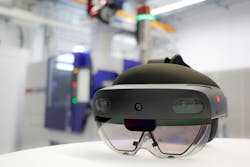
HoloLens glasses 'show future' of virtual-reality technologies in molding
By Karen Hanna
Voice recognition could be coming to injection molding machines (IMM).
Using smart glasses with one option labeled, “show future,” a Wittmann Battenfeld technician addressed an IMM production cell: “Machine, open mold. Robot, go to take-out position.”
And the machines obeyed.
In combination with Microsoft’s HoloLens augmented-reality glasses, the wireless headset used for voice commands was among the products that made a splash Oct. 7 during a virtual Wittmann Battenfeld presentation previewing Fakuma, which opened on Oct. 12. The company calls the arrangement — a research project it has undertaken with several partners — HoloVoice.
“The HoloLens concept itself consists of different possibilities,” said Martin Stammhammer, international sales manager for robots, during the demonstration of the entire system.
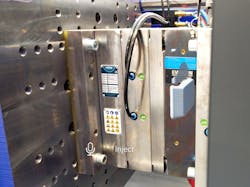
As Stammhammer spoke, software engineer Stefan Dietrich interacted with an IMM line set up at the company’s technical lab in Kottingbrunn, Austria. For several minutes of the demonstration, viewers could see the same view as Dietrich, as a ghostly facsimile of his hand reached out into the augmented reality ether to press buttons superimposed upon the molding cell in front of him. Choices included “manual” and “hide future”; status reports and alarm signals also can be presented to the operator.
One choice, “show future,” allows the operator to see future movements of the IMM and robot.
According to Wittmann Group President Michael Wittmann, who spoke from Fakuma, the future is coming.
“As you can see, this is actually what we can imagine as the user interface of the future,” Wittmann said.
He noted how voice commands already are driving the future of automobiles.
“I would say how do you see the future of voice control for the navigation system in your car? I think it has a big future. … Certainly, there are some kind of challenges that will be unique to it. In the car, you have the background noise, which is very uniform; in a molding shop, you have the background noise, which is not so uniform,” Wittmann said.
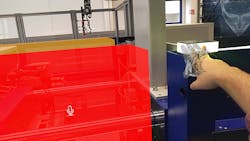
“It means with the whole voice concept, we are able to control the molding machine, as well as the robot, with the voice of the operator without using any touch interface, not off the machine nor off the robot itself. In the next few moments, Mr. Dietrich will generate the path just by activating the machine at the robot by his voice,” said Stammhammer, giving Dietrich the cue to issue his commands.
“Machine, close mold. Machine, inject. Machine, meter.”
Toward the end of his presentation, Dietrich seemed to interrupt the process by exclaiming, “We have to stop this suddenly.”
And he did. Manually.
Stammhammer acknowledged that the technology, which is just now building fluency in English, in addition to German, is still a way’s off. So far, about 1,500 phrases or voice commands have been tested.
But, while still in development, the HoloLens glasses could be a conversation piece at K 2022.
“I would say this in the next couple of years, using voice-recognition becomes more natural, and it will certainly become actually a part of the operation of the molding machine,” Stammhammer said.
Karen Hanna, senior staff reporter
Contact:
Wittmann Battenfeld Inc., Torrington, Conn., 860-496-9603, www.wittmann-group.com
About the Author
Karen Hanna
Senior Staff Reporter
Senior Staff Reporter Karen Hanna covers injection molding, molds and tooling, processors, workforce and other topics, and writes features including In Other Words and Problem Solved for Plastics Machinery & Manufacturing, Plastics Recycling and The Journal of Blow Molding. She has more than 15 years of experience in daily and magazine journalism.