Automation technologies fill in for humans
Turning off the lights while keeping the machines running is a decision that requires attention to all the details. Who — or what — is around to keep things tidy as the machines spit out parts? Where do parts go, and how are they put together, when no one’s around to see them as they’re made?
Addressing the entire process, from resin to final part, are products made by myriad specialists, including makers of robots and automated guided vehicles (AGVs), and even welding-equipment suppliers.
ROEQ
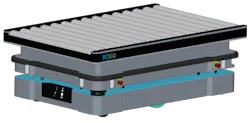
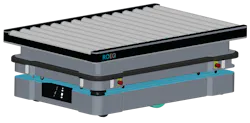
The MiR AGVs are flat, rolling platforms; ROEQ’s portfolio of carts and pallet carriers is designed to mount atop the MiR units to be moved from one location to another, then discharged at a docking station. As they maneuver through a plant, the MiR vehicles automatically compensate for the size of the pallets they are carrying.
The newest ROEQ entries include the TR500 Top Roller, which is designed for the MiR 500. The company’s third and largest unit, it has rollers for easy handling, and accommodates oversized pallets, said Peder Grejsen, technical sales manager for mobile industrial robots for ROEQ. Dimensions are 32.3 inches by 54.7 inches. Maximum capacity is about 1,100 pounds. Carrier height is adjustable as an option.
Also new are the TR125 and C300 carts, which both are compatible with the MiR100 and MiR200 robots.
With a roller area measuring 19.1 inches by 35 inches, the TR125 can be supplied to have either a fixed or adjustable height varying from 25.6 inches to 33.5 inches. When used with the MiR 100, it can carry up to 55.1 pounds; when used with the MiR 200, it can carry up to 275.6 pounds.
The heavier-duty C300 has a frame size of 31.5 inches by 31.5 inches and is designed to carry up to 331 pounds on the MiR100 or up to 661.4 pounds on the MiR200.
Data related to loads and docking are installed manually, but Grejsen said ROEQ is developing a chip that will automatically transfer that information, along with other data. Benefits of the vehicles include accurate tracking of material movement both before and after production.
The MiR AGVs, Grejsen said, are not designed to replace humans. Instead, they allow humans to be reassigned to higher-level tasks. “Repetitious and monotonous work should be left to robots. Humans think and interact, which is what they should be doing.”
DUKANE
Dukane’s ultrasonic and vibration welding units often are installed in multiples on large, automated production lines. Keeping everything running smoothly with minimal human intervention requires robust data-collection and monitoring systems.
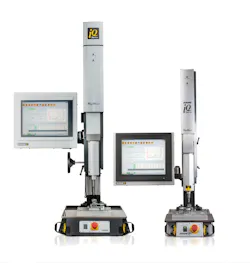
Welders can be securely accessed online globally with the software since each unit has a unique IP address. Once on the network, operators view, analyze, modify and store set-up and operational data.
The iQ Commander extracts data from the welding generator, changes settings, troubleshoots and performs other functions, providing the supervisory insight necessary to allow unattended operations.
Dukane also has developed the 6000 Series servo-controlled vibration welders, which include Melt-Match technology. Melt-Match adjusts Z-axis velocity to the physical state of the plastic being welded. At the start, when plastic is rigid, velocity is slow. As plastic melts, velocity increases and the Z-axis moves down until the weld is complete and holds position as it solidifies. The process improves weld strength and reduces stress.
Unlike Dukane’s pneumatically actuated vibration welders, which do not offer adequate control for a lights-out operation, the 6000 Series boasts the requisite levels of precision and repeatability, Barton said. Dukane plans to show the new welders at K2019.
FANUC AMERICA
Two capabilities in particular enhance automation from robot maker Fanuc America: They are Zero Down Time (ZDT) software and the FIELD System. ZDT has Industry 4.0 functionality, GM Lou Finazzo said, while FIELD allows collection and analysis of data from peripheral equipment.
ZDT users access secure web portals to monitor robots and processing equipment. The software detects process changes, provides operational insight and predicts component failure to prevent downtime. It uses analytics and “deep learning” to optimize plant-wide automation. Through ZDT users can identify potential problems and change operating parameters from outside the plant, allowing them the freedom to let robots run without direct supervision.
The FIELD System allows the connection of plant automation to one server. The server is an open platform; users can develop control and monitoring apps, acquire device-makers’ apps or use third-party apps for operations.
In addition to the software, Fanuc supplies robots with vision systems that can detect bad parts and make adjustments to correct problems. Vision systems also can be used for random part selection from bins and to determine how long it takes a robot to pick and place parts from a mold, which helps reduce cycle times. These capabilities eliminate process variability and importantly, human intervention, a plus, Finazzo observed, because “robots are more intelligent.”
Pat Toensmeier, correspondent
Contact:
Dukane, St. Charles, Ill., 630-797-4900, www.dukane.com
Fanuc America Corp.,
Rochester Hills, Mich., 888-326-8287, www.fanucamerica.com
ROEQ,
Vissenbjerg, Denmark, 45-61-31-0693, https://roeq.dk