Center aids North American manufacturers with foam molding
Engineers at a Canadian research facility are helping North American manufacturers develop new applications for foam injection molding.
For some time, the Fraunhofer Project Centre for Composites Research at Western University has been researching technology for foaming resins, such as nylon 6 and PP, that are reinforced with long glass fibers or carbon. The center also has explored breathing mold technology, in which the mold opens a precise amount during part forming to allow for expansion of the foam. The process reduces the weight of parts, such as dashboards, that are commonly used in the automotive industry.
“Obviously, once you foam the material, it loses some of its mechanical properties, but you do get a lot of weight savings through it,” said Gleb Meirson, a research engineer at Fraunhofer. “So, one thing we are looking at now is to try to co-mold this with continuous-fiber tapes or organo sheets.”
Foamed plastic parts wrapped with continuous-fiber tapes or organo sheets can regain some, if not all, of the resin’s original structural properties, Meirson said.
Meirson said the center is developing a mold that would hold the tapes or sheets in place while foamed resin is injected between the two layers of tapes or sheets. That way, the reinforced foamed product could be manufactured in a one-step or one-shot process. Fraunhofer is looking at several options for holding the tape or organo sheets in place, including grippers, needles or a vacuum inside the mold.
“We will have to see which is the [best] option to do it,” Meirson said.
“One of the benefits of this application is you can strategically reinforce critical areas in your part,” he said. “Not all of your areas have to be reinforced. You can select which areas of your part you want to reinforce with this tape.”
Researchers at the center are working with technologies that already exist and are trying to find new applications for them, he said. For example, several companies manufacture organo sheets and continuous-fiber- reinforced tapes, and Fraunhofer uses MuCell foaming technology developed by Trexel.
“All the research we do is applied,” Meirson said. “We take research that already exists and see how it can be used to make a potential product.”
Foam injection molding is only one of several technologies the center is researching.
Much of what industry currently is doing with foaming and reinforcement with continuous-fiber tapes or organo sheets involves flat structures or local reinforcement, said Stanislav Ivanov, a research engineer at Fraunhofer.
“What we are trying to implement here is more like 3-D shapes – more complex structures,” he said.
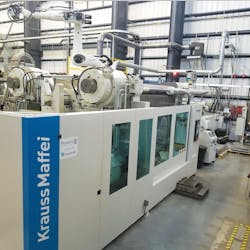
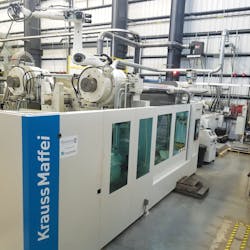
The center uses a KraussMaffei 1600MX-12000 1,600-ton injection molding machine in its foaming research.
“We’re taking a technology that already is commercial and then we try to see the possible applications this technology could work with, and we try to introduce this technology into the applicable industry for this application,” Meirson said.
The center is working with automotive industry companies to find applications for the foaming technology. The center will be developing parts with the technology and testing the parts’ basic mechanical properties. The parts will then be shipped to the OEM and Tier 1 suppliers for more complex mechanical tests.
The center’s role is to help manufacturers determine the feasibility of adopting state-of-the art technologies into their manufacturing processes, Meirson said.
“If you are a company and you hear about this state-of-the-art technology, and you are thinking of trying to develop some parts using this technology but you don’t want to spend a few million dollars to buy this technology and then discover it doesn’t work as you expected or it doesn’t meet your parameters, instead of doing this purchase, you can come to us and we will do this development for you,” Meirson said. “If, at the end of the road, you get the result you want, you can go and invest in this technology.”
Basically, the center helps companies implement new technologies by mitigating the financial risks, he said.
Meirson wouldn’t discuss any of the center’s clients or specific projects it is working on with its foam technology research. However, he cited some products that might be made with the process using continuous-fiber tapes or organo sheets. Examples of potential applications include seats or armrests.
“You constantly apply load to the armrest with your hand,” he said. “If it is strictly foamed material, there is a potential for failure there, but if you reinforce it with continuous fibers with tapes or organo sheets, you provide much more structure to the parts.”
Bruce Geiselman, senior staff reporter
Contact:
Fraunhofer Project Centre for Composites Research
London, Ontario, 519-661-6853, www.eng.uwo.ca/fraunhofer/
About the Author
Bruce Geiselman
Senior Staff Reporter Bruce Geiselman covers extrusion, blow molding, additive manufacturing, automation and end markets including automotive and packaging. He also writes features, including In Other Words and Problem Solved, for Plastics Machinery & Manufacturing, Plastics Recycling and The Journal of Blow Molding. He has extensive experience in daily and magazine journalism.