Peak Nano pushes plastics' molecular architecture
Key Highlights
-
Peak Nano uses precisely controlled nanolayer coextrusion to engineer plastics with enhanced strength, clarity, insulation and permeability properties.
-
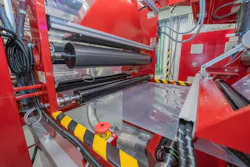
The Ohio company’s five extrusion lines produce films from 6 to 36 inches wide, supporting research, development and high-volume manufacturing.
-
Peak Nano is developing heat-resistant capacitor films that could improve energy storage for data centers and electricity-grid applications.
-
Nanolayer technologies could improve packaging barrier performance while supporting biodegradability, recyclability and reduced long-term microplastic waste.
By Karen Hanna
A blue butterfly doesn’t look that way because of pigment. Give credit to the tiny, intricate structures of the creature’s wings that it can please the eye with colors nature can’t directly create.
“Molecular architecture” is what Zahidul Wahab, a research fellow at Peak Nano, which researches, develops and manufactures film, calls it. And he and partner Michael Ponting, the company’s chief science officer, are taking that idea to manipulate molecules of plastics, building them up like Legos to create high-tech products.
The two men shared their vision for the next stage of polymer property refinement during a Plastics Machinery & Manufacturing (PMM) visit to the company’s Valley View, Ohio, headquarters. Here’s what’s in store: plastic lenses that bend light despite laying flat; film that protects the food within it but biodegrades once its job is done; tiny powerhouse capacitors that will keep their cool even while providing energy to automobiles.
And, yes, even fusion. And who knows? Could invisibility cloaks be far behind?
Over a century of plastics innovation, scientists have developed materials with a broad range of characteristics, but the next generation of innovation goes beyond chemistry. What Ponting and Wahab are chasing represents the next stage of plastics development.
“We don't make the polymer materials,” Ponting explained. “We figure out how to put them together in a way that makes them better.”
Building blocks for "mind-bending" properties
Just as quantum physicists marvel at what’s possible at the very limits of the largest and smallest elements of the universe, Wahab and Ponting see magic at plastics’ most basic levels. Here, resins behave in new — and completely unexpected — ways.
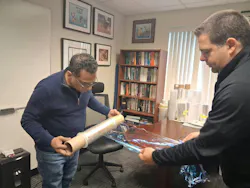
For example, Ponting said of some plastics, “if you put enough layers in them, they'll actually stretch like rubber, which is really counterintuitive and mind-bending.”
Founded in 2016, Peak Nano represents an outgrowth of research by leading polymer scientists, including Pontig, as well as Eric Baer and Lei Zhu, professors of macromolecular science and engineering at Case Western Reserve University (CWRU) in Cleveland.
If you think of layering as sandwiching recycled resin with a virgin material to produce a bottle, this is not that.
According to a press release, Peak Nano’s technologies create films composed of thousands of precisely controlled polymer layers, rather than material blends that have been melted together.
The release states: “This makes it possible to combine several polymer characteristics in one material, almost like a circuit board, creating unprecedented control over properties like atmospherics, molecular permeability, biodegradability, conductivity and insulation.”
In this way, Peak Nano and other companies like it are coaxing properties from traditional plastics that would make no sense to the molders who have melted and formed them for years. The strategy also can result in higher melting temperatures, greater strength or even crystalline clarity, among other characteristics that might ordinarily be alien to a particular material.
“It takes decades for new polymers to come [out] that actually work,” Wahab said. “You cannot wait forever ... so, us polymer engineers, we try to work with them. Traditionally, it was blending, just mixing two things, but it doesn't serve the purpose. And, then, they said, ‘OK, layer it.’ So, now, layering is the next step. ... So, instead of chemistry, we are going to the molecular architecture.”
In his office, Ponting manipulated a thin film in his hands, and it shimmered like oil on the pavement.
It has 257 layers, Ponting said.
“When you put a lot of layers in something this thin, you end up organizing the plastic molecules in a very specific way,” he said “... The layers start becoming the size of individual molecules. When you do that, you get weird properties. ... Strange properties start happening when you control materials down to the single molecule level.”
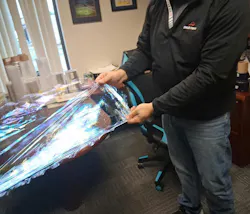
The wrap’s pretty sheen is a bonus, but the way it plays with light has a purpose.
Ponting said a version of it — containing two clear polymers, with no dyes — can be used on windows to block out ultraviolet (UV) light, curbing energy consumption.
“It's the same way nature puts things together, in seashells or butterfly wings. Butterfly wings [have] a color reflection effect like this, [takes] layers and layers of different proteins,” said Ponting, who also noted how natural structures enhance strength, another property that Peak Nano has in its sights.
“Seashells are super strong, almost like a brick wall. Because of how nature built them up,” he said.
Meanwhile, he said, in nearby Solon, Ohio, a second company with CWRU roots called Folio Photonics makes a similar material, using its ability to create molecular structures to form film that can record and store information, much as the grooves on a record translate into music.
Start-up energy drives innovation
In a 25,000-square-foot space once used by a food-services company to store pretzels, Peak Nano runs several lines, testing and developing tooling and processes as part of both in-house projects and custom jobs for customers that include the U.S. military and defense industry.
The building has been devoted to science for over a decade, including a two-year stint as an incubator for Cleveland-based paint specialist Sherwin-Williams Co. At a separate facility in nearby Macedonia, Ohio, the company integrates film into capacitors; that facility also provides storage space.
The company — where Ponting has worked since its inception, when it acquired CWRU spinoff PolymerPlus, a company he co-founded in 2010 — is focused on smarts, not film, ingenuity over equipment. A commitment to be on the cutting edge puts a premium on flexibility, agility and creativity.
There are “lots of idea people here,” Ponting said. “A lot of smart people,” added Wahab, who joined the company about five years ago.
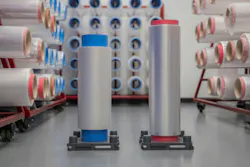
Of a workforce of around 80 people, a handful of employees, including the two men, have earned doctorates. A steady stream of interns, including around 16 last summer, according to Wahab, contribute to the company’s development cycles.
“I'd say we have an internal kind of development group where Wahab and I are, kind of with our crazy ideas, trying to get those papered and tested up and scaled,” said Ponting, a native of Northeast Ohio who grew up with an “inquisitive mind, the science mind” and an inclination toward experimentation.
Over two dozen patents are related to the company’s work.
“The main thing is the technical know-how, experience and finding the right material combination. The technology has been out there for a while, but I don't believe anybody has experienced as much as we did with so many different materials and combinations,” Wahab said.
As an example of the company’s speed-to-market, Ponting cited a contract with one company that sought to replace one material with another using a layer structure. That process took just six months.
Molecular-level control needs the right equipment
There’s no eyedropper small enough to dose resins, no atom collider to manufacture film.
The process requires specialized tooling, much of it devised in-house by three tool makers.
Ponting explained that Peak Nano designs tooling that divides materials layer by layer, before forming it. The feedblock starts with three to five layers, and the layered melt stream is split, separated and stacked.
“You do it through a controlled flow process,” he said. “You're literally flowing melted stream, two materials into a channel. That's the block, cutting that channel now in two halves, so you have two layers on the right, two layers on the left. … Then, those two channels will then recombine and form inside of each other. … We have to really understand the rate of material flow and temperature.”
A bad process that combines the layers improperly quickly announces itself.
“It's either what you want, or it's going to be a hot, molten mess,” Ponting said.
As a testament to its commitment to creating film and processes that are replicable and ready for market, Peak Nano uses five extruder lines from a variety of OEMs, including Steer, Collin and Davis-Standard, which Ponting said has been making layered films for about 20 years.
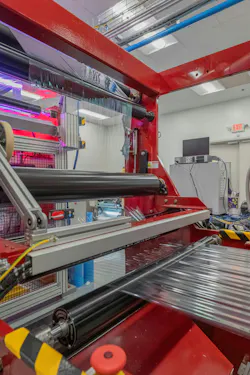
The machines are sized for film widths between 6 inches and 36 inches, and for demand ranging from R&D production to high-volume manufacturing. Depending on the application, film thicknesses go down to about 6 microns.
Though Peak Nano uses between one and four materials in any of the individual products it makes, it has expertise in a wider range of materials than most extrusion processors, including PP, PE, PET, fluoropolymers, rubber and urethane, Ponting said.
The film Peak Nano produces, with its unique characteristics, relies on “90 percent commercial machinery, 10 percent our special sauce kind of stuff,” Ponting said.
“The best part is, we use mostly commercial machinery, because in plastics, usually the products require a lot of whatever it is,” he said.
Practical results to solve real problems
While he loves science, Ponting isn’t at Peak Nano to discuss theory or scrawl esoteric equations across a chalkboard.
He’s looking for something tangible — “very solid, real things” — and gets a charge from seeing how science can address real-world problems.
“I’ve always got to go, ‘How can I make things better? ‘How can this get better?’ ” he said.
At Peak Nano, that’s the mission.
One major project is improving capacitor film.
If manufacturers can unlock a way for film to capture energy more tightly, they will be able to manufacture capacitors with more energy-storage space, or capacitors that can store the same amount of energy as competing units while taking up less space. These energy-dense capacitors could be smaller, or handle bigger tasks. Capacitors that can tolerate higher temperatures, meanwhile, can charge and discharge energy more quickly.
“Film capacitors, they use biaxially oriented polypropylene (BOPP) almost 90 percent of the time, but BOPP has a continuous-use temperature, so it cannot go beyond 85-105 degrees C [Celsius]," Wahab said.
But data centers, for instance, need capacitors that can handle much higher temperatures.
“You need almost a super BOPP or super-polypropylene,” Wahab said.
The company is working toward qualification and commercialization of better films, for applications that also could include electricity-grid storage.
Nanolayering has provided a solution where previous extrusion processors using other, more conventional approaches failed.
“They have blended it, or they have done micro-extrusion, where they have like seven or nine layers, but it doesn't solve the purpose. But when we started putting them in, like, hundreds to thousands of layers, we started seeing some synergistic effect. … We were able to increase the surface temperature by almost 30 degrees,” Wahab said.
Wahab said he also sees possibilities for sustainability — his personal goal is to create a material that can return to the environment as easily and cleanly as it protects food from the environment.
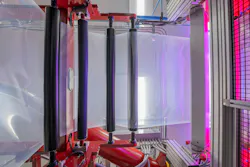
According to a Peak Nano press release, conventional packaging contains tight bonds of polymers and additives that hurt recyclability and eventually slough off into the environment. It says, “The nanolayer coextrusion and biaxial orientation processes also boost oxygen and water‑vapor resistance, improving durability so the films can withstand real‑world converting and packaging operations without contributing to long‑term microplastic waste.”
The next frontier of nanolayer technologies
In an office decorated with Cleveland baseball memorabilia, including a picture of the grand opening of the team’s current ballpark in 1994, Ponting was looking ahead.
He and Wahab showed off lenses they’ve made from plastic that can be used in optics for users that include military personnel. They’re flat and easily shipped; they’re also more durable than glass.
Ponting said stronger-than-glass materials also might protect pictures and shield them from UV rays.
By warping light, nanolayers also might render invisible what’s right in front of your face.
The future is now. Ponting is in awe — Peak Nano is working on film that can store energy from fusion.
A Northeast Ohio native, he said he thinks the region’s blend of industry and science education makes it a perfect incubator for Peak Nano’s continued growth. Right now, the company handles about 50,000 pounds of film a year.
But, just like a capacitor built for energy potential, Peak Nano is ready for a surge. In coming years, Ponting said it could double or triple its employee roster.
It will be spreading its wings right where it started.
“The goal is to continue to scale and grow here in Northeast Ohio,” he said. “Our hopes, dreams and plans right now are to add a couple more lines and fix our capacity for the millions of pounds.”

About the Author
Karen Hanna
Senior Staff Reporter
Former Senior Staff Reporter Karen Hanna covered injection molding, molds and tooling, processors, workforce and other topics, and features including In Other Words and Problem Solved for Plastics Machinery & Manufacturing, Plastics Recycling and The Journal of Blow Molding.