Problem Solved: Blenders boost efficiency for extruders
Problem: A custom sheet extrusion company was searching for a blending system to provide tighter controls on the components being blended.
Solution: Three gravimetric batch blenders have reduced waste and provided tighter control over the blending process.
A custom sheet extrusion company has better control over its resin formulations since adding three gravimetric batch blenders to its mix of equipment.
“We were looking to go with a more modern blending system that was more intuitive and user-friendly,” said Eddy Pack, a plant manager at Select Plastics. “We wanted a turnkey system that would give us tighter controls on the components we are blending.”
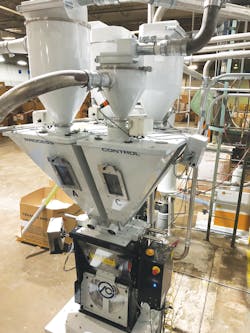
To boost production and reduce waste, last summer it added a multilayer extrusion line, three Process Control Corp. (PCC) gravimetric batch blenders, a dust collector, vacuum receivers, sequencing valves and a vacuum pump.
“We were drawn to Process Control by their sturdy design and the accuracy of their blenders, as well as ease of use and ease of changeover,” Pack said. “We had worked with PCC on some pieces of equipment previously, but nothing large-scale like this.”
The system has helped Select Plastics better maintain consistency and product quality.
“The gravimetric blenders and other components were sized to our specific needs,” Pack said. “The blending systems are very precise. We program them for the product we are running at the concentrates that the supplier tells us to use, and it nails it every time. It offers better controls and precise blending. That gives us better color consistency in the products that we make.”
The blending systems also have improved efficiency.
“It has improved efficiency not only with the material, but in the changeover process,” Pack said. “It allows for quick changeovers. We can drain, clean and change products quickly.”
The three Guardian Series 2 gravimetric batch blenders provide precise batch-to-batch dispensing and consistent homogenous blending, said Adam Venable, a sales and marketing associate with PCC.
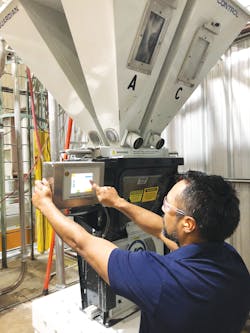
Standard features include off-the-shelf controls, a color touch screen, cartridge gates with V-gate metering that can be easily removed, segmented material hoppers, an integral drain chute and a “no-dead-zone” mixing chamber.
The Guardian Series 2 blenders can be equipped with as many as 12 ingredient hoppers, with dispensing accuracy within 0.02 percent, Venable said.
The Guardian Series 2 comprises six models with volumes of 2.2 pounds, 5.5 pounds, 11 pounds, 26.5 pounds, 40 pounds and 55 pounds, and a maximum throughput of more than 10,000 pounds per hour. Select Plastics installed one 11-pound and two 5.5-pound gravimetric blenders.
“The batch blenders are equipped with PCC VacuBloc manifolds that reduce the vacuum lines required to only one central line,” Pack said. “This allows for much neater and streamlined installation. The manifold holds all the sequencing valves that operate from the single vacuum line. The compressed air needed to operate the sequence valves also comes from the VacuBloc, so you only need one compressed air line to the manifold. This gives you the ability to remote-mount or blender-mount the VacuBloc for easier maintenance and cuts down on installation time and costs.”
The blending system is intuitive to use, according to Pack.
“A sequencing manifold fires the different hoppers and the dust collector in sequence,” he said. “The hoppers feed the gravimetric blender. A nice touch-screen interface on the gravimetric blenders turns on the manifolds that you use to establish how much component will be blended. It’s a very intuitive system. The number on the touch screen is associated with the manifold sequencing valve that is associated with one of the hoppers that it fills, for the various components that we blend together. We can load up to four components in each of the three gravimetric blenders.
“For example, if you need two resins and a color concentrate for an extruder, you turn on three hoppers at the interface to load materials into each of the hoppers. You program at the gravimetric blender how much of the materials you want to load in each batch.”
TRAINING AND SERVICE
The process of ordering the system through installation at the plant took about four months, according to Pack. That includes system design, manufacturing and installation.
“We were up and running at the end of May 2018, and there was no downtime during the installation process,” he said. “A complete new line with a new blending system was installed. We are making many different multilayer structures with this new line and can run all of our products with tremendous consistency.”
Due to the intuitive nature of the equipment, training went smoothly, Pack said.
“PCC did the training. They sent techs down at startup, and we started production with them here,” he said. “Their techs did the programming and trained us how to run the system. They were here about two days. We already had the new equipment installed when their techs arrived.”
There was only one minor hiccup after installation, which was quickly resolved by PCC to Pack’s complete satisfaction.
“There are little things we learned, and Process Control learned also because this is their new blending system,” Pack said. “We learned that, in cleaning the system out for changeovers, there was a design flaw, which we reported, and, in a few days, their engineering group had a solution to it and shipped it to us. We installed it, and the issue was completely resolved.”
Bruce Adams, senior staff reporter
Contact:
Process Control Corp., Atlanta, 770-449-8810,
Select Plastics,
Fort Worth, Texas, 817-595-3804,