Mridula (Babli) Kapur earns SPE Blow Molding Divison Lifetime Achievement Award
Key Highlights
-
Mridula (Babli) Kapur received the 2026 Lifetime Achievement Award for advancing polyolefin materials, product development and blow molding technology.
-
Kapur developed bimodal polyethylene resins that improved processing-performance balance while maintaining physical properties for blow molding applications.
-
Her work shaped Dow’s gas-phase polyethylene technology roadmap, integrating catalyst innovation, polymer design and blow molded article performance.
-
Kapur’s career includes 55 U.S. patents, more than 180 internal technical reports and recognition from plastics and science organizations.

Mridula (Babli) Kapur was honored with the Lifetime Achievement Award at the 2026 Annual Blow Molding Conference. She recently retired from Dow as a principal R&D fellow after nearly 35 years of service in Spain, the Netherlands and Texas.
She played a pivotal role in advancing the polyolefins business through materials‑science‑driven innovation, portfolio expansion and differentiated product development from concept to commercialization.
Kapur developed a novel multifunctional product quality control analyzer, now deployed globally across all Dow polyethylene manufacturing plants. She has designed resins across the entire polyethylene spectrum, enabling flexible and rigid packaging, durable goods, pipe and automotive applications.
She was instrumental in shaping Dow’s global gas‑phase asset and technology strategy and was the driving force for the multi‑generation gas‑phase polyethylene technology roadmap, integrating both catalyst and product innovation, including the development of a comprehensive blow molding product portfolio.
Dow assigned her to its gas-phase polyethylene product development team after its acquisition of Union Carbide.
“That is where I really got into blow molding technology — especially bimodal blow molding resin development,” Kapur told Scott Steele in an interview for The Journal of Blow Molding in 2025.
“It was a very fast education because I did not know anything about blow molding at the time. What I did have was a strong foundation of analytical and materials science. I was also knowledgeable on how to correlate materials science to market applications — that is, how to connect process and catalyst technology to resin structure to achieve the desired performance of the end-use fabricated article.”
She initially worked on creating Ziegler-Natta-catalyzed bimodal grades for blow molding. That led to a series of film, sheet, pipe, injection molding and rotomolding resin developments for diverse applications ranging from packaging to durable goods, automotive and infrastructure.
Her team at Dow worked on the fundamentals of correlating dual reactor gas-phase UNIPOL II process technology, catalyst innovation, polymer design and blow molded article properties. This resulted in the creation of a portfolio of bimodal polymers that were excellent blow molding resins.
“I wouldn’t say Dow invented the first bimodal blow molding resin, but we significantly improved their processing-performance balance without sacrificing the physical properties,” she told Steele in 2025.
In recent years, she led the Safer Materials R&D initiative, encompassing substances of concern, microplastics and recycling stewardship. This requires not only new material development but also expanding analytical, digital, and predictive capabilities and fostering external cross‑sector collaborations.
Steele, an SPE Blow Molding Division board member, announced at the annual conference in Chicago that Kapur was the 2026 Lifetime Achievement Award recipient.
"Her resume is extensive, and the story that she told us through the plastics magazine a couple years ago is incredible," Steele told conference attendees. "She was principal research fellow at Dow, which is a pretty high standard, and I think she was one of the first women that achieved that rank ... She's one of those people who can tell you how all the molecules go together and how you build polymers that have certain properties."
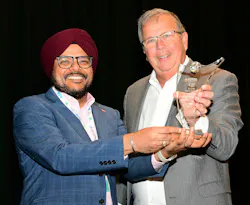
Kapur couldn't attend the conference, but had one of her Dow colleagues, Harpreet Singh, read a statement on her behalf thanking the SPE Blow Molding Division for the honor.
She noted that she started her career in the polymer field "quite late," after acquiring a doctorate in physical chemistry and working on the development of novel amorphous semiconductors, "nothing related to polymers or plastics."
She faced a steep learning curve.
"However, I had specific aspirations," she said in her prepared comments. "I wanted to excel in technology development, not just doing good, sound science, but science that provided practical, value-added solutions to my company and society ... I wanted to innovate and create technologies that were effective and implementable."
She noted she has also drawn immense satisfaction from developing the next generation of professionals within and outside of Dow.
"I am in awe of their talent and the value-added, life-changing discoveries that are yet to come," according to her statement.
Kapur was educated in India and earned entry into a prestigious doctoral program at the National Chemical Laboratory in Pune, India, but a chance meeting with a visiting Texas A&M University professor led her in a new direction and her eventual Ph.D. from Texas A&M. The university's Department of Materials Science and Engineering recently honored her with the Legacy of Service Award for her sustained contributions marked by integrity, leadership and excellence.
She is a Fellow of the Society of Plastics Engineers and has coauthored more than 180 internal technical reports, delivered numerous external presentations and published widely. Her portfolio includes 55 granted U.S. patents.
Kapur's honors also include the 2022 American Chemical Society Heroes of Chemistry Award and the 2024 Society of Asian Scientists and Engineers Career Achievement Award.
This article appears in the fall 2026 issue of The Journal of Blow Molding.
© 2026, Society of Plastics Engineers Blow Molding Division