Gerald Hobson saw opportunity in blow molding tooling
By Scott Steele
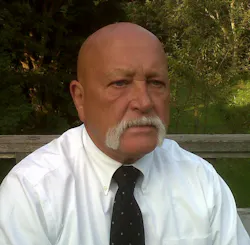
The professionals who build molds and tooling are an often-overlooked driver of the blow molding industry. Gerald Hobson is one of the tool makers who go back to the roots of the industry.
Mold making — or pattern making, in die-casting lingo — is a combination of technical skill and artistry that turns two-dimensional sketches into working three-dimensional parts.
Gerry, as he is called by his many friends, was trained as a pattern maker in an apprentice program offered by John Deere starting in 1966. In his early days, he made patterns, which were foundry tools for die casting.
Today, design is done in three dimensions by computer-aided design programs, and models are printed by rapid prototyping machines. But in the early days, the tool making process involved a pattern maker that transformed customers’ concepts into working designs.
At John Deere, pattern makers needed to learn the intricacies of tooling and the sandcasting process over a five-year program. Companies often sponsored such programs to allow people to work while they were learning, but that arrangement had some drawbacks.
“I was working the foundry making $4.40 an hour. They cut the pay in half when I entered the apprentice program. Somehow, we got by on $80 a week,” Gerry said.
He enjoyed his time at Deere and learned how to build patterns for a variety of cast metal parts including engine blocks and transmission casings.
Gerry and three partners left John Deere to start Century Pattern in Cedar Falls, Iowa, in 1976. They enjoyed several productive years, but in 1982 there came a disagreement in the forward strategy.
A friend of Gerry’s had shown him a plastic blow molding machine and its tooling. Compared to a sandcasting pattern, which required cores to hollow out portions of the part, a blow mold was much simpler and only required machining of the part shape into the metal block. Gerry believed the tooling would be a new opportunity for the business, but his partners were committed to the sandcasting business.
He got tired of arguing with his partners and in 1982 started Hobson Brothers Aluminum Foundry and Mold Works with his two brothers, Dennis and Floyd, and together they built one of the best shops in the industry. Not only did the company build molds and run a small foundry, but it it also developed parts and routinely sampled molds and showed customers how to run them.
To build the business, the brothers added blow molding and metalworking equipment by going to auctions and hauling used gear in their own trailers. “It was tough. We didn’t have any money, but we worked hard and worked a lot of hours,” Gerry said.
Customers who received untested molds often insisted something wasn’t right because they couldn’t run them, which led to returns and delays.
“Not all the blow molders were technically savvy and sometimes we’d send tools in that they couldn’t make work,” he said. “They would run the wrong material, or the wrong-sized head tooling, or they lacked training and blamed the mold.”
Gerry and his brothers found blow molding machines that they used to prove the mold and provide the customer with confidence in their design. Hobson kept expanding and taking on newer molding technologies the brothers picked up from OEMs.
Gerry was involved in some of the early rapid prototyping efforts when in about 1995 Hobson purchased a Layer Object Manufacturing (LOM) machine. A LOM took a roll of paper and laid down one sheet of cut paper at a time to build up a pattern. Hobson had its own foundry and used the LOM pattern to cast a mold, which it sampled in a 30-pound blow molding machine.
“We sent Ford a mold, on a pallet, with a part in 10 days from when we received an order,” he said. At the time, the normal turnaround for prototype parts would have been months; 10 days is still pretty good by today’s standards.
One thing Gerry found interesting was a technology the brothers found in Japan from a company called Placo. The machine could make air duct tubes with combinations of materials like Santoprene and PP in the same part. The brothers also got a deep draw machine from the same company.
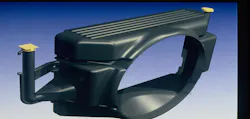
He recalls making a part for Chrysler — a radiator cowling with integral hollowed-out compartments for radiator overflow and windshield wiper fluid. One part replaced at least three components.
“That mold was very busy. The parison came down, and we had to pre-pinch it. The mold had to fold, with a bunch of parts that had to slide into it,” he said.
He borrowed some of those techniques from his die-casting experience.
Hobson is known for his willingness to share his knowledge and educate customers in the technology of blow molding. The Hobson mold making company held annual seminars that attracted hundreds of people. The seminars built goodwill with their customers, often leading to repeat business. Gerry is also a longtime board member of the SPE Blow Molding Division and teaches a very popular beginners’ class in part design.
Like many businesses at the close of the 1990s, Hobson faced mounting pressure from the business’ lender, which got nervous about the uncertainty of manufacturing businesses beyond Y2K. It became too difficult to continue doing business, and the shop — which had about 140 employees and $10 million in sales — was forced to close.
“Those were some bad days. When you have that many employees, and you can’t continue, it hurts, but my faith carried me through it,” he said.
It wasn’t a total loss, because his son-in-law, Steve Sterling, decided to start Hawkeye Preferred Tooling. Hawkeye became very successful, and, like Hobson, it is a combination tooling business with a molding operation.
Gerry's son, Andy, also works in the blow molding business as a sales manager at Bekum, and is a board member of the SPE Blow Molding Division.
Gerry has spent the years since 2000 consulting for molders who rely on his 50 years of experience. Now approaching 79, he has slowed down some, but still is involved with his family and community. (A side note: He took the first interview for this column while driving a tractor over to a neighbor’s house who needed some help.)
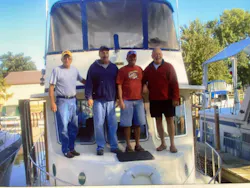
He is an avid outdoorsman. With his brothers, he completed the “Great Loop” in a trawler that went 8 miles per hour. The Great Loop is the 6,000-mile route that starts in the Great Lakes, runs through the St. Lawrence River to the Atlantic Ocean, going around Florida to the Mississippi River and up through a lock and canal system back to the Great Lakes. It took the Hobsons 17 two-week stints over three years.
He also enjoys motorcycling and has run many extended trips to the West and East coasts with his brothers. His 2017 Harley trike has 55,000 miles on it. It’s not all outdoors though; Gerry concedes he and his brothers did a lot of camping at Holiday Inns. He now chases grandkids and great-grandkids who race motorcycles throughout the Midwest.
He has five children, 14 grandchildren and five great-grandchildren. The oldest great-grandchild, Royce, whom Gerry calls Rolls, turned 5 in March. Gerry splits time between his native Iowa and winters in Hernando Beach, Fla.
This article appears in the spring 2026 issue of The Journal of Blow Molding.
© 2026, Society of Plastics Engineers Blow Molding Division
About the Author
Scott Steele
Scott Steele is the owner of SWS Consulting LLC in Perrysburg, Ohio. An expert in reheat stretch blow molding, he has been a member of the Society of Plastics Engineers for more than 30 years and has held positions as chairman and director of the Blow Molding Division. Contact him at [email protected].