For the second year, the Blow Molding Division’s Knowledge and Technology Group has sponsored a senior student team focused on the effects of post-consumer regrind (PCR) in blow molded parts.
Students in the capstone course in the Department of Plastics Engineering Technology at Pittsburg State University in Pittsburg, Kan., are working together to understand the complete blow molding process from material selection to part processing to analysis of the finished bottle.
Hayden Sprague, Tyler Glass and Emily Welch began work in August to produce an HDPE oil/automotive additive bottle with the use of a one-quart oil bottle mold, donated by Chevron Phillips, Bartlesville, Okla.
The students blended two HDPE virgin resins provided by Chevron Phillips with HDPE PCR provided by Arch Plastics Packaging in Chattanooga, Tenn., to create compositions of either 25 percent or 50 percent PCR by weight. They used the material to produce bottles on a Rocheleau R-4 extrusion blow molder, and compared the resulting bottles to 100 percent virgin HDPE bottles.
As the project continues through the end of the semester in May, the students will analyze the effect of PCR content on top load, drop impact and environmental stress cracking resistance properties. The team meets every two weeks virtually with the Student Project subcommittee of the Knowledge and Technology Group to review progress and ask questions.
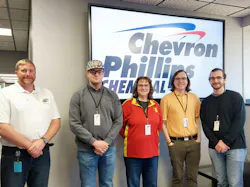
In mid-December, the students traveled to Chevron Phillips in Oklahoma to visit Division board member Justin Lumbley, a PSU alumnus and technical service engineer for the company, along with their PSU mentor, Dr. Jeanne Norton, and graduate student Jacob Culross. They got a tour of the facilities and gained a better understanding of the factors that affect blow molded bottle production and the testing of blow molded parts.
After successful bottle production and analysis, students will recommend process parameters and let-down ratios (virgin to HDPE PCR) to produce quality bottles that can withstand real-world conditions while optimizing PCR content. Students will also calculate costs associated with material, energy, machinery, labor and packaging components for a projected annual production volume of 2 million bottles manufactured with their recommended parameters and let-down ratios.
The students plan to present their work in the form of a poster at the 41st Annual Blow Molding Conference Oct. 5-7 in Chicago.
Those interested in future student projects may contact Mike Misco ([email protected]) or Joe Slenk ([email protected]).
This article appears in the spring 2026 issue of The Journal of Blow Molding.
© 2026, Society of Plastics Engineers Blow Molding Division