Latest systems advance separation technologies
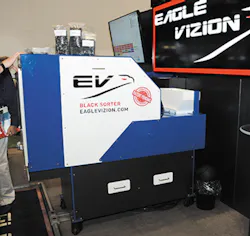
Several firms debuted equipment to sort recyclables at NPE2018 in Orlando, Fla.
EAGLE VIZION
Eagle Vizion introduced a sorter for black plastics, which can be difficult to separate because the material doesn't reflect light. The new Black Sorter uses a different type of infrared scanner to determine flake size, President Nathanaël Lortie said.
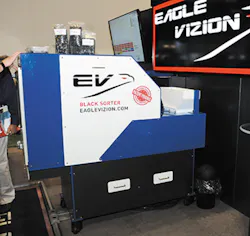
"The main difference with this sorter versus our standard sorters is that we analyze spectral images outside the standard [near-infrared] range," he said. The illumination source also is designed specifically for this spectral range.
The sorter classifies black plastic flakes by polymer type, discerning among PE, PP, a blend of the two, and others. "We started with the PE/PP simply because our first customer for the black polymer sorter was in that field, and we collaborated with them," he said.
The company is testing the sorter on other plastics, including PET, PC, ABS, PS, polyamide and polymethyl methacrylate. The company will update the sorter's software as each material is validated, Lortie said.
The camera can detect particles as small as 0.5mm, but typically, particles range in size from 5mm to 25mm.
Eagle also debuted a melt sorter, which can sort PE flakes with three melt grades — injection molding grade PE, blow molding grade PE and high-molecular-weight PE. Traditionally, it has been hard for recyclers to guarantee that their end products are of a particular melt grade. With the new sorter, recyclers can ensure that they meet market expectations with PE that is a specific melt grade.
"Recyclers have issues controlling the melt," Lortie said. "This sorts out PE by viscosity."
The new melt sorter has a throughput of about 1,600 pounds an hour for rigid materials, or 1,000 pounds per hour for thin-wall materials, he said. It can handle flakes 5mm and larger.
TOMRA
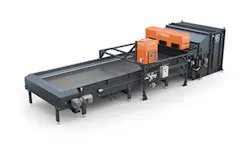
Tomra Sorting Solutions unveiled its latest technology, Tomra Sharp Eye, which allows its Autosort machines to separate single-layer PET thermoformed trays from PET bottles.
The subtle chemical differences between materials used in the two products mean that thermoformed PET trays are considered contaminants that have to be removed from bottle recycling streams.
The key is an improvement to Tomra's Flying Beam technology, a near-infrared (NIR) scanning system used in its Autosort machines. The Sharp Eye technology introduces a camera with a bigger lens. The cameras are key, as they provide a higher light intensity and resolution, allowing the machine to detect properties that are difficult to distinguish, said Carlos Manchado Atienza, the company's regional director of the Americas.
The Autosort machine with Sharp Eye detects materials and colors in combination with particle size. Even with a highly mixed input material, the process achieves sorting accuracy of 95 percent or better.
Sharp Eye also improves the Autosort machine's previous ability to separate out multilayer PET trays. And, the artificial intelligence embedded in Tomra systems enables analysis of the sorted products.
PELLENC
Pellenc presented its new film sorting machine, the Mistral+ Film Top Speed.
The sorter has higher throughputs, a key requirement for LDPE film recyclers, the company said. A standard machine from Pellenc or competitors typically can sort 1.5 tons per hour. The Mistral+ Film Top Speed can reach throughputs as high as 4.5 tons per hour.
The throughput increase comes from the speed of the infeed conveyor. Standard optical sorters operate at a maximum of 7.9 feet per second when handling films. The Mistral+ Film Top Speed drives its belt at 14.8 feet per second with a sorting performance similar to standard machines, the company said.
The machine, which Pellenc said costs only a little more, means that recycling facilities can see a greater return on investment or even take on projects not possible previously. The machine is available beginning this month.
The Mistral+ Film Top Speed includes the company's Turbosorter, which the company describes as a stabilization tunnel for the sorting of lightweight objects. It creates linear air flow at a precisely controlled speed. This keeps film from flying around and allows the machine to maintain a high throughput.
The machine comes in widths of about 4 feet, 5.3 feet, 6.6 feet, 7.9 feet and 9 feet.
Mistral+ Film Top Speed in particular can help address the thorny problem of recycling grocery bags, which tend to fly around when being conveyed, said Roger Brown, sales and service manager for the company.
SATAKE
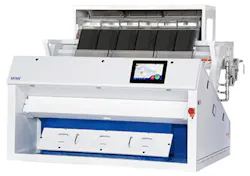
Satake introduced its RNEZS series of full-color optical sorters to the plastics industry at NPE2018; the machines previously had been used for handling grain. The sorters are larger than Satake's FMS2000-F sorter, which also has gotten some upgrades in the past year.
Machines in the RNEZS series use a similar optical sorting technology as the FMS2000, but have a higher production capacity, said Gabe Rieger, marketing specialist for Satake. The RNEZS 2500 model has three chutes, the 4500 has six and the 6500 has nine. "So, if higher production capacity is the need, the RNEZS will be the solution," he said.
When sorting plastics, the machine can handle from 1,000 to 2,000 pounds per hour per chute, depending on the material type and contamination level. RNEZS-series sorters can handle pellet, flake and regrind, and sort by color, size and shape.
Rieger said Satake has worked to reduce the price of its machines to make them more cost-effective. "Satake has been a pioneer in plastic sorting for a couple decades, but, in the past, the technology just wasn't well-suited for plastics, with one of the biggest concerns being the price of the machines," he said.
The recent updates for the FMS2000 include a vibratory feed delivery system and an ionizer bar for static control, Rieger said. That machine can sort 1,000 to 4,000 pounds per hour by color, size and shape.
NATIONAL RECOVERY TECHNOLOGIES
National Recovery Technologies (NRT) showcased its new Visual Identification System (VIS). It uses NRT's Max-AI (artificial intelligence) technology to identify materials, improve sorting accuracy and provide recyclers with information.
VIS can be used to identify items by material type at various points in the recycling line. The data from VIS can be fed to NRT's Total Intelligence Platform, which allows operators to log in from anywhere and track the data in real time, as well as trending information, with an intuitive user interface. It offers easy-to-view graphs and charts to help operators analyze outbound residue and product quality, as well as throughput, uptime and downtime events.
This replaces audits, which can require lengthy amounts of time, said Peter Raschio, marketing manager for NRT's parent, Bulk Handling Systems, Eugene, Ore.
VIS can be integrated into lines that use optical sorters. While the AI uses multilayered neural networks and a visible-light vision system to identify materials similar to how a human would separate, an NIR optical sorter identifies materials by their composition.
"Combining these technologies provides new capabilities for high-volume sorting," Raschio said.
VIS is able to differentiate between types of PET and keep the trays out of the bottle stream.
Allan Gerlat, correspondent
Contact:
Eagle Vizion, Sherbrooke, Quebec, 819-481-1325, www.eaglevizion.com
National Recovery Technologies (NRT),
Nashville, Tenn., 615-734-6400,www.nrtsorters.com
Pellenc ST America Inc.,
Fort Mill, S.C., 803-396-3990,www.pellencst.com
Satake USA Inc., Stafford, Texas, 281-276-3600, www.satake-usa.com
Tomra Sorting Inc.,
West Sacramento, Calif., 916-388-3900,www.tomra.com/en/sorting/recycling