Energy Recovery: Auxiliary suppliers work to minimize energy use
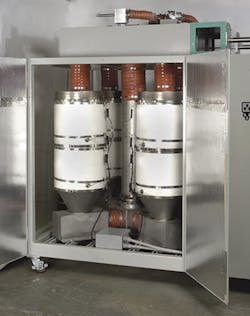
One of the biggest advantages that American businesses have is energy, which costs less and is more reliable in the U.S. than just about anywhere else in the world. However, even in the U.S., energy recovery can provide financial rewards for users of both primary processing equipment, as well as auxiliary equipment.
Regenerative power technology provides the greatest benefits in applications that require both a large draw on power, and a subsequent drop or pause in energy consumption. Auxiliary equipment suppliers have used power regeneration and other creative techniques to ensure businesses get the maximum value from every bit of energy they draw.
Dri-Air Industries
Dri-Air has made a firm commitment to incorporating energy recovery into its product lineup. Its technology now is available as an option on its floor-mounted, four-bed HP4-X 1500 and 3000 FM dryers. The number in the product names refer to the process rate in pounds per hour. "This option is now available on new 1500 and 3000 lines, shortly followed by the 400-1000 in the next few months," said Jason Sears, the company's VP of operations. "The option will be available on smaller units later this year, on floor-mount and portable units."
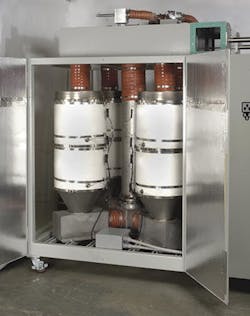
Dri-Air's approach to energy recovery focuses on airflow. During the regeneration cycle of a multi-bed dryer, one bed removes moisture from air being recirculated from the drying hopper. At the same time, a second bed is being heated to remove moisture from the desiccant.
During the regeneration cycle's heating phase, air is directed out of the dryer to expel the moisture. Once the top of the bed has reached its highest temperature, all the moisture has been removed and the regeneration air is dry.
"At this point, the residual heat in the bed has to be cooled before switching the airflow to put the bed online," Sears said. "We have incorporated a valve system to redirect the regeneration air, which is now dry, into the process air, thus recovering the residual heat from the bed."
In addition to recovering that energy, this modification actually increases the performance of the dryer itself by reducing the amount of air required for the regeneration cycle. Initial tests show an additional 10 percent to 20 percent energy savings, depending on the size of the dryer.
"While our current design uses 50 percent less than the energy of wheel dryers, the additional savings is considerable," Sears said. "This is made possible by the constant monitoring of the temperatures within our dryers and the flexibility of our Dri-Touch microprocessor control."
Siemens Industry
Motors account for more than 65 percent of all industrial power demand, according to Siemens, and that's why the company's Sinamics S-series of multi-axis drives holds so much potential in plastics. The S120 line of variable-frequency drives not only increases efficiency by optimizing motor control, it features Active Infeed Technology, which takes energy that's usually wasted and returns it to the power grid.
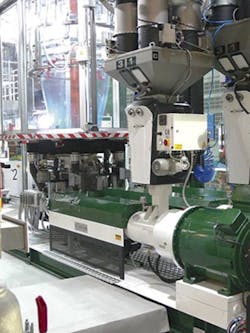
It's especially effective for tasks that require frequent starts and stops, deceleration with a high inertial load, and overhauling torque applications such as downhill conveying. All of those activities generate a lot of kinetic energy, and when they need to be slowed or stopped, it's often lost, usually in the form of heat.
But it doesn't have to be that way. "In common DC bus and regenerative drive systems, nearly all the energy can be recovered and used productively, with a very short payback time for the added investment," said Craig Nelson, a product marketing manager with Siemens.
The net energy savings achieved by reusing this otherwise-wasted energy varies but can be significant. "It depends on the machine and operation," Nelson said. "For applications that have vertical hoisting or continuous-servo positioning, an overall drive system power reduction of close to 40 percent can be achieved in many instances." Generally speaking, the more energy-intensive a task is — or the longer a motor needs to operate at a partial load — the greater the potential to capture energy and return it to the power supply.
Siemens is working to make the drives more powerful, as well as more compact, said Mathias Radziwill, business development manager. "Our drives are becoming smaller, with higher overload capabilities," he said. "The amount of space required beneath the motor modules has been reduced … thanks to improvements in the design and a new motor plug connector."
Leister Technologies
If there's one area in which energy recovery seems like a natural fit, it's in recapturing and reusing heat, because plastics facilities generate a lot of it. For auxiliary equipment like ovens and dryers, producing heat is job No. 1.
Once the heat has done its job, such as curing composite parts in an oven, it is often allowed to dissipate, even though it could be used for another purpose.
Leister has developed a hot-air recycling system that does exactly that. Conceptually, it's simple. A blower pushes air through a heater and into a dryer or an oven; the heated air comes out of the oven and is redirected back to the blower to begin the cycle again — only this time it starts with very hot air that has been recirculated rather than dissipated.
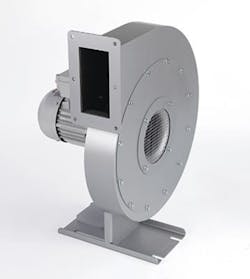
The tricky part was finding components that could handle the heat, product specialist Jason Sanders said. "To recycle the hot air from a process, both the blower and the air heater need to be able to withstand the high temperatures at the air-inlet side," he said.
Leister's solution consists of one of its double-flange air heaters — either the LE 5000 DF-R or LE 10000 DF-R — and its RBR blower; those heat-resistant components are able to endure temperatures up to 1,112 degrees Fahrenheit.
The company initially struggled to find a cable that could handle those high temperatures, but eventually it discovered a cable that, when insulated, can handle temperatures up to 600 degrees Fahrenheit.
With a more heat-resistant cable, even more energy could be recovered.
The payoff of hot-air recirculation can be substantial. Without it, a system with an airflow of 4,000 liters per minute, operating 24 hours a day, 220 days per year, would consume about 202,315 kilowatt-hours (kWh) of energy.
When equipped with one of Leister's double-flange air heaters and the RBR blower, energy consumption is almost cut in half, requiring only 106,482 kWh. At today's cost of about 13 cents per kWh, that adds up to a savings of $12,500 annually.
Mike McCue, copy editor
For more information
Dri-Air Industries Inc.,East Windsor, Conn., 860-627-5110, www.dri-air.com
Leister Technologies LLC, Itasca, Ill., 855-534-7837, www.leister.com
Siemens Industry Inc.,Alpharetta, Ga., 770-751-2447, www.usa.siemens.com