Avex printers build large-format parts
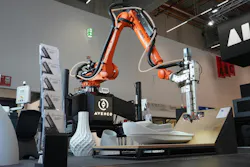
Avex Using servo-controlled extrusion to ensure repeatability and reliability, this series of robotic, large-format additive manufacturing (LFAM) technologies for reinforced thermoplastics, such as PET-glycol, glass-filled PP and carbon-fiber-filled PC and nylon, performs continuous, multiplanar printing. The printers, from Avenco 3D, Istanbul, are appropriate for the defense, aerospace and aviation, marine, furniture and architecture sectors. Each of the models — including Avenco’s Avex15, Avex20 and Avex32 models — features reinforced-polymer-ready screw/barrel geometry, interfaces for seamless robotic integration and four-zone heating with a maximum temperature of 842 degrees Fahrenheit. Manufacturers can use the printers to produce rapid prototypes and low- to mid-volume large thermoplastic parts that would be impractical or uneconomical to produce with injection molding. Possible parts include molds, jigs, fixtures and tooling, layup and vacuum form tools, drill jigs, non-flight composite tooling, aerodynamic mockups, form/fit prototypes, boat hull sections, large sculptural shells, upholstery molds, lighting housings, and automotive body panels and bumpers.
What’s new? The LFAM systems, which Avenco showed in the fall at Formnext, where it used one of the printers to produce a jet ski part, and at the Bosphorus Boat Show, where an Avex15 system produced a boat component measuring about 13.1 feet by 3.9 feet. Over the past year, Avenco has refined its technologies for thermoplastic pellet extrusion, based on industrial robotic platforms. Recent updates include increased and more-stable material throughput suitable for long production cycles; the addition of system architectures optimized for tooling, mold and large-part manufacturing; and new configurations designed to support hybrid manufacturing, combining additive printing with CNC machining in a single robotic cell. Avenco is working to become more active in the U.S. market in the second half of this year, and its printers are available through 3D Home Building.
Benefits Design freedom for lightweight, high-strength geometries; lower material waste, compared with subtractive manufacturing methods; and reduced lead times for large tooling and prototypes. Also, the technologies are compatible with composite manufacturing workflows, including autoclave-based processes.
3D Home Building LLC, Wichita, Kan., 316-765-0500, www.3dhomebuilding.com, www.avenco3d.com
Vital Statistics
|
Model |
Dimensions |
Weight |
Nozzle size |
Screw diameter |
Maximum hourly throughput |
|
Avex15 |
About 5.9 feet by 2.3 feet by 1.9 feet |
About 172 pounds |
2mm to 16 mm |
25mm |
About 33 pounds |
|
Avex20 |
About 4.8 feet by 2.3 feet by 1.7 feet |
About 185 pounds |
2mm to 16 mm |
25mm |
About 55 pounds |
|
Avex32 |
About 5.9 feet by 2.3 feet by 1.9 feet |
About 309 pounds |
2mm to 16 mm |
35mm |
About 110 pounds |
About the Author
Karen Hanna
Senior Staff Reporter
Senior Staff Reporter Karen Hanna covers injection molding, molds and tooling, processors, workforce and other topics, and writes features including In Other Words and Problem Solved for Plastics Machinery & Manufacturing, Plastics Recycling and The Journal of Blow Molding. She has more than 15 years of experience in daily and magazine journalism.