Light-curing system remedies production problems involving nasal swabs
Problem: A maker of nasal swabs couldn’t cure the swabs as quickly as it could 3D print them.
Solution: A UV light curing system with a conveyor facilitated a 36-fold increase in production.
By Karen Hanna
When the COVID-19 pandemic struck, a company that makes movie props, among other products, found a new role — making nasal testing swabs using 3D printers. But its first efforts suffered from slow production times — until an ultraviolet (UV) light curing system shed some light on the situation.
“They were not able to [meet production needs] just using the LEDs that are basically built in the 3D printer itself,” said Eugene Mikhaylichenko, sales and marketing director for Uvitron, a UV-system maker that worked with Production 3D to boost production of its Nasopharyngeal NP Swabs.
According to JR Nichols, project and print manager for Production 3D, an Anaheim, Calif., manufacturer of props, toys and other products, the company initially made only 3,600 parts every 24 hours in the early days of the COVID-19 pandemic, using EnvisionOne 3D printers from EnvisionTEC US LLC, Dearborn, Mich.
With the integration of Uvitron’s curing systems, production levels rocketed to 129,000 parts per day.
Production 3D originally couldn’t cure the swabs — made of E-Guide Soft biomedically safe resin from EnvisionTEC — as fast as it could print them, Mikhaylichenko explained.
“They could have printed a lot of these nasopharyngeal swabs relatively quickly, but they were looking for the post-curing system that can basically solve the problem of the bottleneck,” he said.
Uvitron’s UV technologies offer a spectrum of solutions, from wands to apply light to small areas to huge systems that can be paired with conveyors to handle large parts and big volumes. Mikhaylichenko said the conveyor approach met the production goals of Production 3D.
“It requested a few samples to be sent to us, to verify that our systems can basically keep up with the production demands that they had. So, they sent a few samples; we ran those different settings, different belt speeds on the conveyor, different wavelength, different intensity levels, and confirmed that the results were great,” Mikhaylichenko said.
When matched with its flood-lighting systems, the conveyor systems from Uvitron can move up to 58 feet per minute, depending on the exact configurations users choose. The conveyors range from 9 inches to 33 inches wide.
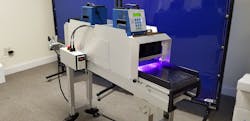
For the project with Production 3D, Uvitron contributed its UV Conveyor 40 Plus and SkyRay 800 LED lamp technologies.
The UV Conveyor 40 Plus is a bench-top or stand-mounted UV curing conveyor system designed for laboratory or high-volume production applications. The 63.2-pound system measures 4.5 feet by about 1.2 feet by 1.3 feet.
The SkyRay systems have a 5-foot-by-5-foot curing area.
Nichols said his company was satisfied with the solution.
“Uvitron is a very professional company. When we had this special need for a COVID-19 fighting product we were producing, we sent samples in, and they matched us with the proper equipment.”
In addition to curing 3D-printed parts, Uvitron’s technologies can be used for a variety of applications, including in the manufacture of other medical and dental parts. Other applications include curing clear plastic clamshells for packaging and creating protective coatings for plastics.
Mikhaylichenko — one of just 14 people who work for the company — said he and his team took special pride in being able to help Production 3D.
“I think that’s the biggest satisfaction for us as the manufacturer was being able to provide a solution that basically helps people directly with the pandemic.”
Karen Hanna, senior staff reporter
Contact:
Uvitron International Inc., West Springfield, Mass., 413-731-7835, www.uvitron.com
About the Author
Karen Hanna
Senior Staff Reporter
Senior Staff Reporter Karen Hanna covers injection molding, molds and tooling, processors, workforce and other topics, and writes features including In Other Words and Problem Solved for Plastics Machinery & Manufacturing, Plastics Recycling and The Journal of Blow Molding. She has more than 15 years of experience in daily and magazine journalism.